

A control arm is a hinged suspension link that connects your truck’s chassis to the wheel hub, guiding vertical wheel travel while keeping the tire planted on the road. It works with a ball joint and bushings to control camber, caster, and toe. Once those wear points fail, alignment and handling suffer immediately, and a $80 to $150 alignment is mandatory after any replacement.
TL;DR:
- Worn bushings or ball joints in control arms can cause alignment shifts, steering instability, and uneven tire wear, necessitating an immediate wheel alignment after replacement.
- Parts costs for control arms range from $60 to $280 depending on material and design, while installation typically costs between $250 and $700 per side, with heavier trucks at the top of that range.
- Most control arms last the lifetime of the vehicle unless impacted by hard knocks, but bushings and ball joints usually require replacement due to wear over time.
- Upgrading control arms with aftermarket kits addresses factory geometry limits, especially on lifted trucks or off-road vehicles, and specific kits are available for GM trucks, Polairs RZR, and other models.
- Always confirm your vehicle’s exact year, axle configuration, and ball joint type before purchasing control arms, and budget for an alignment fee to prevent rapid tire wear.
Types of Control Arms and Where to Find Them
Most trucks and SUVs run upper and lower control arms on each side of the front suspension, forming what’s commonly called an A-arm or wishbone setup. Passenger cars and crossovers with MacPherson strut front ends typically use only a lower control arm, since the strut itself handles the job an upper arm would otherwise do. Rear independent suspensions on many trucks and SUVs also use control arms, so don’t assume the issue is limited to the front end.
Materials vary by application:
- Stamped steel is the most common and budget-friendly, found on most factory-equipment trucks.
- Cast aluminum shows up on many modern passenger vehicles for weight savings.
- Forged steel or aluminum appears on performance and off-road-focused aftermarket kits, built to handle repeated impact loading.
Look underneath your front wheel well. If you see two separate arms stacked vertically, connecting to a spindle, you’re looking at a double control arm design. One arm connecting to a strut means MacPherson.
How Control Arms Control Your Suspension Geometry
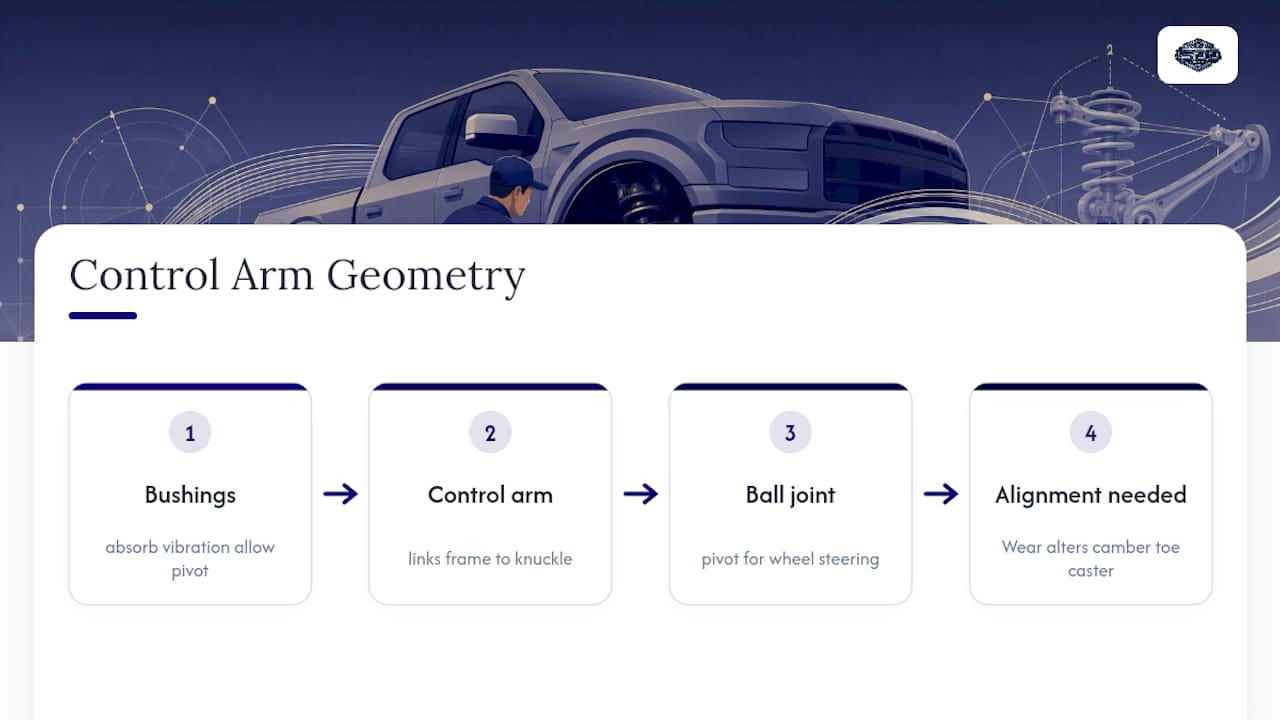
Each control arm connects to the frame through rubber or polyurethane bushings on the inboard side and to the steering knuckle through a ball joint on the outboard end. The bushings absorb vibration and allow the arm to pivot as the suspension compresses and rebounds. Over time, rubber bushings crack, harden, or separate from their metal sleeves, letting the arm shift out of its intended position.
The ball joint acts as the pivot point that lets the wheel turn while the arm moves up and down. It’s a wear item by design, and once the internal bearing loosens, you get noticeable play in the wheel.
Either failure changes your alignment specs. Worn bushings let the arm drift, altering camber and toe. A loose ball joint changes how the steering knuckle sits relative to the arm, throwing off caster. That’s why any control arm replacement requires a wheel alignment afterward, not just a suggestion but a functional necessity for even tire wear and predictable steering.
Symptoms That Point to a Bad Control Arm
A failing control arm rarely stays quiet. Watch for these signs:
- Clunking or knocking over bumps — usually the loudest and most obvious symptom, especially from lower control arms.
- Steering wander or vagueness — the truck feels like it’s hunting for center on the highway.
- Uneven or accelerated tire wear — often on the inner or outer edge of the tread.
- Vibration through the steering wheel — particularly at speed or under braking.
A wooden-sounding thud over sharp-edged bumps usually points to bushing failure, while a sharper metallic clunk suggests ball joint or hardware looseness. Technicians confirm bushing wear with a simple visual check paired with a pry-bar test, levering the arm while watching the bushing for movement it shouldn’t have.
Lower-arm failures tend to announce themselves loudly, while upper-arm wear can be subtler, sometimes showing up only as a slight alignment drift. Because these symptoms overlap with tie rods, sway bar links, and strut mounts, a lift-and-shake inspection at a shop is worth the diagnostic fee when you’re not sure.
Pro Tip: Jack up the front end and grab the tire at the 3 and 9 o’clock positions. Rock it side to side. Play in the wheel with no corresponding movement in the steering wheel usually points to a ball joint, not a tie rod.
What Control Arm Replacement Actually Costs
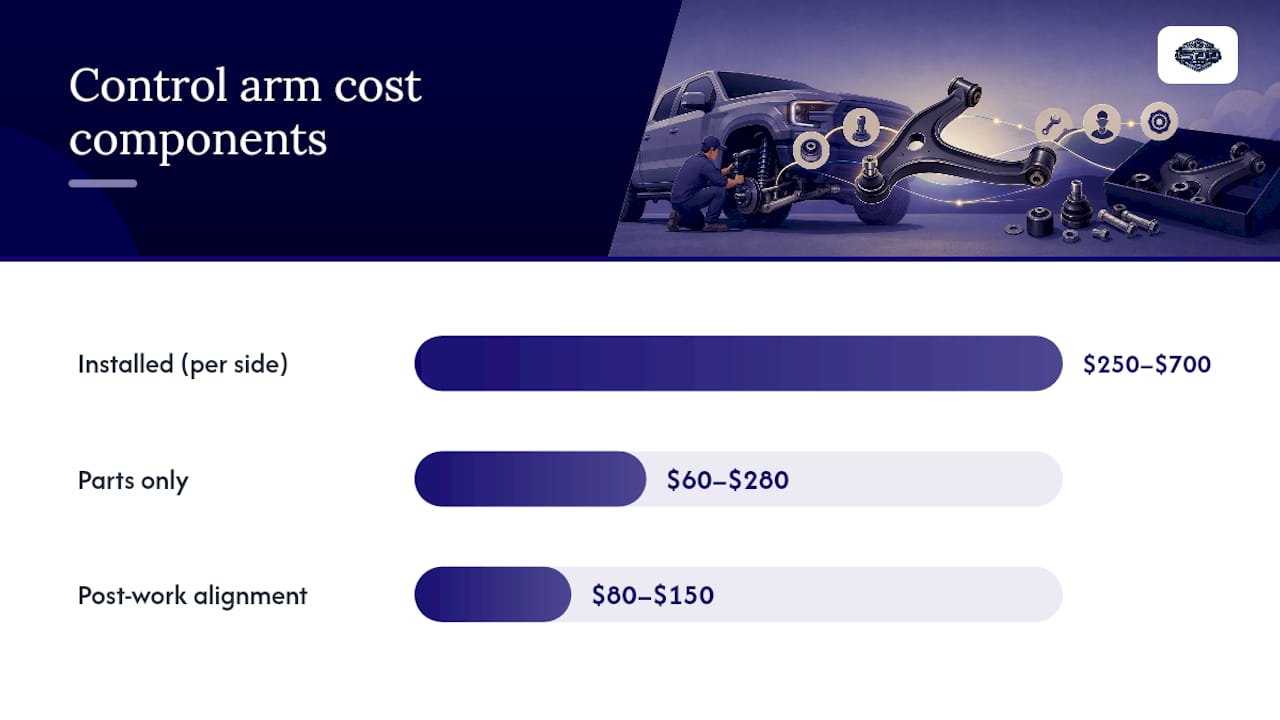
Budget matters here, and the range is wider than most people expect. Installed control arm replacement typically runs $250 to $700 per side for most vehicles, with heavier SUVs and trucks often landing at the top of that range or above it. Parts alone run roughly $60 to $280 depending on whether you go aftermarket or OEM, and whether the ball joint is riveted into the arm or replaceable on its own.
Here’s what drives the price up or down:
- Integral vs. serviceable ball joints — modern arms with cast or riveted-in ball joints require replacing the whole arm, which adds parts cost.
- Vehicle class — half-ton trucks and UTVs generally cost less per side than heavy-duty diesel trucks with larger, more complex front ends.
- Aftermarket vs. OEM — aftermarket kits often cost less and sometimes upgrade materials or geometry over stock.
DIY difficulty on this job rates roughly 6 to 8 out of 10. You’ll need a torque wrench, breaker bar, and a ball-joint separator at minimum, and a hydraulic press for jobs that require pressing in new bushings. Seized bolts are the usual reason a two-hour job turns into a Saturday-long project.
Whatever you replace, always budget $80 to $150 for the alignment that follows. Skipping it invites rapid, uneven tire wear that erases any money you saved. Many shops also recommend replacing both sides at once on higher-mileage trucks, since it saves labor time and you’re only paying for one alignment instead of two down the road.
How Long Control Arms Actually Last
The arm itself often outlives the truck around it. The bushings and ball joints are the real wear items; the structural arm typically lasts the vehicle’s service life unless it’s bent by a hard impact. Most owners see a long service life before bushings or ball joints need attention, though rough roads, aggressive towing, and curb strikes can shorten that lifespan.
A few habits stretch that lifespan. Avoid hitting curbs and potholes hard, inspect the front end after any significant impact, and replace torn bushings as soon as you spot them rather than waiting for a full failure. A separated or badly worn ball joint needs immediate attention since it can let the wheel fold under the truck. Mild bushing wear can usually wait a few weeks for a scheduled repair. On a high-mileage truck, doing both sides together often makes more sense than fixing one and revisiting the other next year.
How Standard Diesel Direct Supports Your Control Arm Upgrade
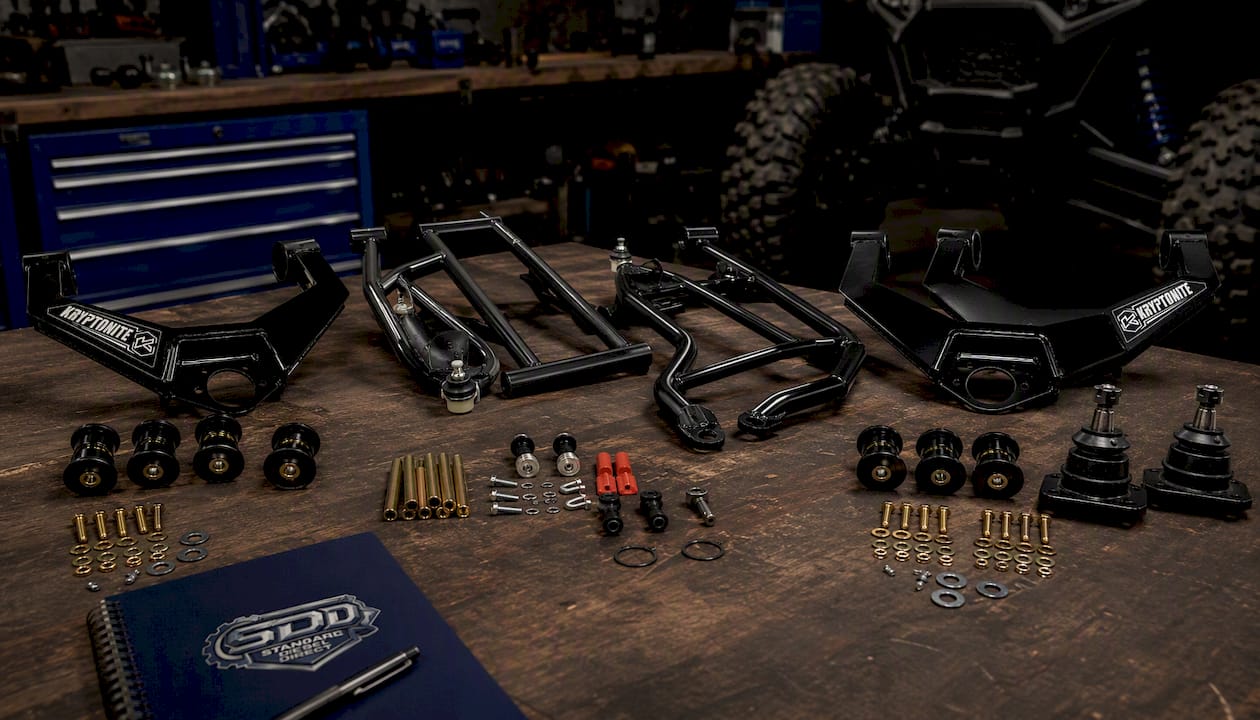
Certain aftermarket parts catalogs focus specifically on light-duty diesel trucks and side-by-sides, offering control arm kits built around real-world fitment rather than generic replacements. For GM trucks from 2020 to 2024, the Kryptonite Upper Control Arm Kit addresses factory geometry limits that stock arms struggle with under lift or load. Older half-ton owners running 2014 to 2018 GM trucks have a dedicated option in the Kryptonite Upper Control Arm Kit for 6-lug trucks. UTV owners aren’t left out either. The Axiom Supply High Clearance Control Arm Kit fits Polaris RZR S 800 models from 2009 to 2014 and solves ground clearance issues that stock arms create on rough terrain. If you’re keeping your factory arms, a matched ball joint package for stock control arms pairs cleanly with GM trucks from 2001 to 2010.
Buying the Right Control Arm Kit for Your Truck
Picking the correct kit comes down to matching your exact year, drivetrain, and axle configuration before you check out. Here’s the quick version:
- GM trucks, 2020 to 2024: the Kryptonite Upper Control Arm Kit is built for factory geometry corrections under lift, which stock arms don’t handle well long-term.
- GM half-ton trucks, 2014 to 2018: the 6-lug Kryptonite kit fits a common platform many owners run for years past factory suspension life.
- Polaris RZR S 800, 2009 to 2014: the Axiom Supply high clearance kit solves ground clearance limits that stock arms create on technical trails.
Before ordering anything, confirm your exact model year and axle code since GM trucks in particular run multiple front-end configurations across a single generation. Check whether your current setup uses a riveted or replaceable ball joint, since that affects whether you need a separate ball-joint package alongside your new arms. And build the $80 to $150 alignment cost into your total budget from the start rather than treating it as an afterthought. If your suspension work overlaps with tuning or calibration changes, a resource like Diesel Torque Optimization covers the calibration side of a broader upgrade. For the alignment itself, a shop offering dedicated suspension and alignment services will get the geometry dialed in correctly after any control arm swap. If you’re not sure which kit matches your build, Some retailers provide fitment guides on their product pages that help walk through the specifics before purchase.
Sources
- Control arm — Wikipedia
- Control Arm Replacement Cost 2026: Parts, Labor & DIY Savings — AMP Auto
- Control Arm Replacement Cost: What You’ll Actually Pay — San Diego Bumper & Collision
- 7 symptoms of worn control arm bushings — The Motor Guy
- Control Arm Replacement Cost in 2026 — Empire Auto Protect
FAQ
What Does a Control Arm Do?
A control arm links the chassis to the wheel hub and guides how the wheel moves up and down while keeping the tire in proper contact with the road. It also houses the ball joint that lets the wheel turn for steering.
What Happens When a Control Arm Goes Bad?
You’ll typically notice clunking over bumps, steering wander, vibration, or uneven tire wear as the bushings or ball joint wear out. A fully separated ball joint is a safety hazard since it can let the wheel fold under the truck.
How Much Does It Cost to Replace a Control Arm?
Installed replacement typically runs $250 to $700 per side, plus $80 to $150 for the required alignment afterward. Heavier trucks and SUVs often land at the higher end of that range.
How Many Control Arms Are on a Vehicle?
Most trucks and SUVs have four control arms total, an upper and lower arm on each side of the front end, though MacPherson strut vehicles use only a lower arm per side. Many rear independent suspensions add additional control arms as well.
Should I Replace Both Control Arms at the Same Time?
Replacing both sides together often makes sense on higher-mileage trucks since it saves labor and you only pay for one alignment instead of two separate visits down the road.