

Diesel fuel economy is defined as the distance a diesel-powered vehicle travels per gallon of fuel consumed, and targeted improvements can cut operating costs significantly. Diesel owners who combine smart driving habits, engine parameter tuning, and proper maintenance consistently achieve the largest gains. The North American Council for Freight Efficiency identifies speed management and idle reduction as two of the highest-impact levers available. Standard Diesel Direct works with diesel truck owners daily and confirms that most operators leave real MPG gains on the table by overlooking simple, low-cost adjustments. This guide covers every major category, from ECM settings to fuel system hardware, so you can act on what matters most.
How do driving habits influence diesel fuel efficiency?
Speed is the single biggest controllable variable in diesel fuel consumption. Reducing highway speed from 70 to 65 mph saves roughly 0.5 MPG, which adds up to approximately 869 gallons annually at 120,000 miles. That translates directly to thousands of dollars saved without touching the engine.
Acceleration style matters just as much as top speed. Hard, jackrabbit starts force the engine to work at peak load, burning far more fuel than a gradual, steady throttle application. Smooth acceleration keeps the engine in its most efficient torque range and reduces wear on drivetrain components at the same time.

Idling is one of the most overlooked fuel drains in diesel operation. A diesel engine burns 0.8–1.5 gallons per hour at idle, meaning eight hours of unnecessary idling wastes up to 12 gallons per day. Auxiliary Power Units (APUs), which typically cost $3,000–$10,000, pay for themselves in under 18 months by eliminating most of that idle fuel burn.
Cruise control on flat terrain improves fuel economy by 3%–6% by holding a consistent speed. Speed variability, even minor surges and drops, forces repeated acceleration events that compound fuel waste over long distances.
- Reduce highway speed to 65 mph or below when conditions allow
- Apply throttle gradually from stops and low speeds
- Shut the engine down during extended stops instead of idling
- Use cruise control on flat, open highway sections
- Consider an APU for overnight or extended rest periods
Pro Tip: Set a personal speed ceiling of 65 mph on highway runs and use cruise control whenever traffic allows. That one habit alone can recover close to a full MPG on long hauls.
What maintenance and mechanical adjustments boost diesel mileage?
Engine health is the foundation of fuel economy. Clean air filters and proper exhaust after-treatment often deliver more MPG gains than power modifications, because a restricted intake or a clogged DPF forces the engine to work harder for the same output. Replacing a clogged air filter costs under $50 and can restore measurable efficiency immediately.
Fuel filters and injector condition directly affect combustion quality. Dirty injectors produce uneven spray patterns, which leads to incomplete combustion and wasted fuel. A clean, properly atomizing injector set burns fuel more completely, which shows up as better mileage and less black smoke at the tailpipe.
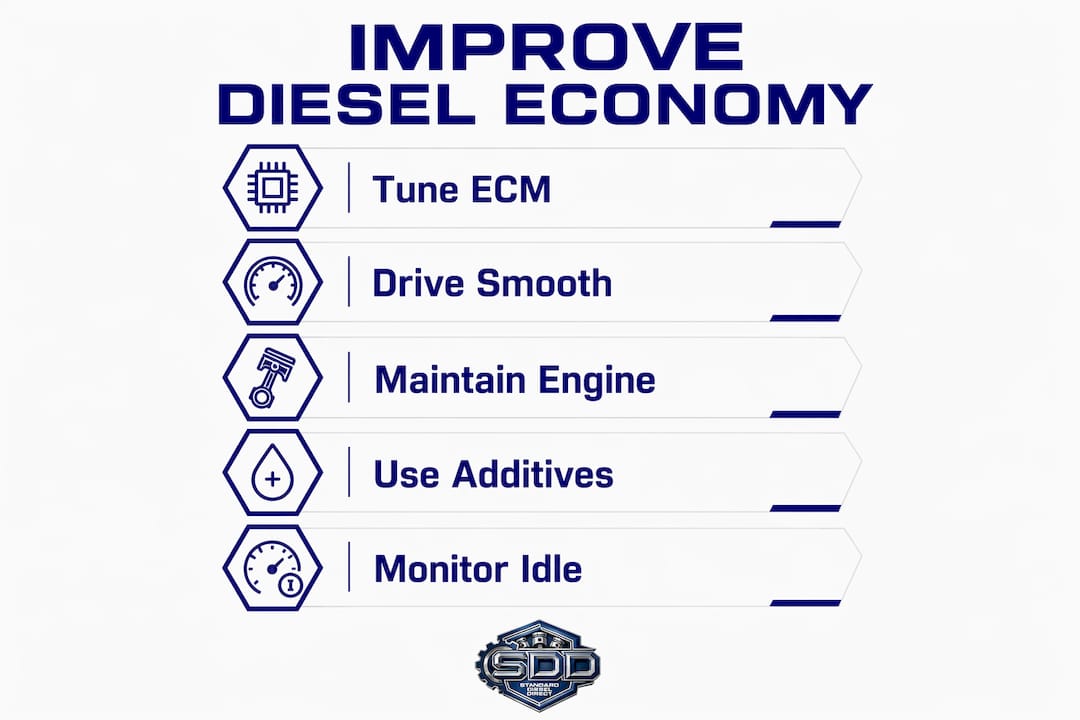
ECM parameter tuning is where many diesel operators find the most cost-effective gains. Electronic engine parameter optimization yields a 5%–8% MPG improvement at zero hardware cost by adjusting speed limiters, idle shutdown timers, and shift RPM settings. An average gain of 0.5 MPG through ECM adjustments alone is achievable on most modern diesel platforms.
One underappreciated risk is parameter reset during routine maintenance. Engine parameters such as idle timer and shift RPM limits are reset inadvertently during routine maintenance, which silently erases previously dialed-in efficiency settings. Scheduling a parameter audit after every major service prevents this from happening unnoticed.
Key mechanical checkpoints to address in order:
- Inspect and replace the air filter if restriction exceeds manufacturer spec
- Replace the fuel filter on schedule, or sooner if fuel quality is suspect
- Check engine oil viscosity and condition; use the OEM-specified grade
- Pull ECM fault codes and review live data before ordering any replacement parts
- Audit ECM parameters including idle shutdown, speed limiter, and shift settings
- Test injector performance and clean or replace as needed based on diagnostic data
| Maintenance Item | Fuel Economy Impact | Cost Range |
|---|---|---|
| Air filter replacement | Restores intake flow; measurable MPG gain | $30–$80 |
| Fuel filter replacement | Improves combustion consistency | $20–$100 |
| ECM parameter tuning | 5%–8% MPG improvement at zero hardware cost | $0–$200 (labor) |
| Injector cleaning or replacement | Reduces incomplete combustion | $100–$800+ |
| Oil and fluid service | Reduces internal friction | $50–$150 |
Pro Tip: Always pull live diagnostic data with an OBD-II scan tool before replacing any sensor or mechanical component. A $30 scan often reveals the real cause and saves hundreds in unnecessary parts.
How do fuel additives and fuel system upgrades impact diesel efficiency?
Diesel additives work best when expectations are realistic. Additives primarily improve lubricity and cetane rating rather than delivering dramatic MPG jumps. Their real value is protecting fuel system components and maintaining consistent combustion quality over time.
Cetane improvement matters because higher cetane fuel ignites more reliably under compression, reducing combustion delay and improving power delivery per injection event. Lubricity additives protect high-pressure fuel pumps and injectors from wear caused by ultra-low sulfur diesel (ULSD), which has less natural lubricity than older diesel formulations. Consistent additive use extends the service life of these expensive components.
Additives reduce fuel particle size below 400 microns and improve combustion efficiency at the molecular level. That improvement is real, but it shows up more as protection and consistency than as a sudden MPG spike on the gauge.
Hardware upgrades to the fuel delivery system address a different problem: fuel starvation and aeration. A lift pump upgrade or a complete aftermarket fuel system ensures the high-pressure injection pump receives a steady, clean, air-free fuel supply. Fuel starvation causes the injection pump to work harder and wear faster, which degrades both performance and economy over time. The FASS DMAX7001 fuel system for GM Duramax 6.6L engines is one example of a hardware solution that improves flow and filters contaminants before they reach the injection system.
Additive and hardware categories at a glance:
- Cetane improvers: Raise ignition quality for more complete combustion
- Lubricity additives: Protect ULSD-stressed pumps and injectors
- Deposit control additives: Keep injector tips clean for consistent spray patterns
- Lift pump upgrades: Eliminate fuel starvation and aeration at the injection pump
- Filtration systems: Remove water and particulates before they cause injector damage
What operational strategies can diesel operators implement for consistent savings?
Fuel economy is an operational discipline, not a one-time fix. Treating fuel economy as a weekly operational priority with continuous driver engagement and periodic ECM audits sustains savings that hardware alone cannot maintain. Operators who check their numbers weekly catch problems before they compound.
Driver incentive programs produce measurable results. Incentive programs encouraging smooth acceleration and braking can reduce fuel consumption by roughly 400 gallons per driver annually. A $50 monthly bonus for hitting MPG targets costs far less than the fuel saved, making it one of the highest-return investments a fleet can make.
Tire pressure is a maintenance item that directly affects rolling resistance. A tire underinflated by 10 psi consumes significantly more fuel over thousands of miles, comparable to the losses from aerodynamic drag. Checking tire pressure weekly takes five minutes and costs nothing.
Aerodynamic considerations also add up on highway-heavy routes. Side skirts, cab extenders, and trailer gap reducers all reduce drag at speed. These are not luxury upgrades; on routes where the truck runs 65 mph for hours at a time, aerodynamic drag is a constant, measurable fuel cost.
- Check tire pressure weekly against manufacturer spec, not the sidewall maximum
- Review telematics or trip data weekly to spot idling and speed violations
- Schedule ECM parameter audits after every major service event
- Run driver MPG reports and share results with operators directly
- Inspect aerodynamic components for damage or missing panels each quarter
Pro Tip: If your truck or fleet has telematics installed, set an idle-time alert threshold of five minutes. Catching idle events in real time changes driver behavior faster than any monthly report.
How to troubleshoot and avoid common mistakes that reduce diesel fuel economy?
The most common mistake diesel owners make is replacing parts before reading diagnostic data. Diagnostic data review via OBD-II tools identifies fuel economy killers like sensor faults and boost leaks that drivers miss entirely. A MAF sensor reading slightly out of range will not trigger a check engine light immediately, but it will skew fueling and cost MPG for weeks before anyone notices.
Boost leaks are another silent efficiency killer. A small crack in an intercooler pipe or a loose clamp reduces charge air pressure, which forces the ECM to add more fuel to compensate. The engine runs richer than necessary, MPG drops, and the root cause never shows on the dashboard.
ECM parameter resets after shop visits are a frequent, underappreciated problem. A dealer or independent shop that flashes a software update or replaces a module can inadvertently restore factory default parameters, erasing months of tuning work. Always verify ECM settings after any shop visit that involves module programming.
- Pull OBD-II live data and fault codes before ordering any replacement part
- Inspect all intercooler pipes, boots, and clamps for boost leaks under load
- Verify MAF sensor readings against spec; clean or replace if values are off
- Confirm ECM parameters after every shop visit involving module work
- Do not rely on additives or hardware alone if driver behavior is the primary problem
Fuel economy gains from hardware and additives are real, but they are capped by driver behavior and engine health. A truck with a boost leak, a reset ECM, and an aggressive driver will underperform regardless of what is bolted to it. Fix the foundation first, then layer in upgrades.
Fuel system upgrades from Standard Diesel Direct
Standard Diesel Direct carries a full lineup of FASS Titanium Signature Series diesel fuel systems built for light-duty diesel trucks, including GM Duramax, Ford Powerstroke, and Ram Cummins applications. These systems address fuel starvation, aeration, and contamination at the source, protecting your injection pump and injectors while supporting consistent fuel delivery under load.
The Titanium Signature Series 220GPH for 2020–2022 GM Duramax 6.6L engines is a high-flow option rated for 900–1,200 horsepower builds, delivering 70–75 PSI of clean, air-free fuel to the injection system. For Ram 1500 Ecodiesel owners, the FASS TSD11140F110G provides a purpose-built solution for that platform’s specific fuel system demands. Standard Diesel Direct provides product education alongside every purchase so you install the right system for your engine and power level.
FAQ
How much fuel can better driving habits actually save?
Reducing highway speed from 70 to 65 mph saves approximately 869 gallons annually at 120,000 miles. Combined with idle reduction and smooth acceleration, driving habit changes often deliver the largest single-category MPG gains available.
Does ECM tuning really improve diesel fuel economy without hardware?
ECM parameter optimization yields a 5%–8% MPG improvement at zero hardware cost by adjusting idle shutdown timers, speed limiters, and shift RPM settings. It is one of the highest-return adjustments available to diesel operators.
Are diesel fuel additives worth using?
Diesel additives improve lubricity and cetane rather than producing large MPG jumps. Their primary value is protecting fuel system components and maintaining combustion consistency, which supports long-term efficiency.
What is the fastest way to find a fuel economy problem?
Connect an OBD-II scan tool and review live data before replacing any part. Faults like MAF sensor errors or boost leaks degrade fuel economy significantly before a dashboard warning light appears.
How often should ECM parameters be checked?
ECM parameters should be audited after every major service event involving module programming or software updates. Parameters such as idle timer and shift RPM limits are reset inadvertently during routine maintenance, silently erasing efficiency gains.
Key Takeaways
The most effective way to improve diesel fuel economy combines ECM parameter tuning, disciplined driving habits, and proper fuel system maintenance, because no single fix addresses all three root causes of poor mileage.
| Point | Details |
|---|---|
| Speed management saves the most fuel | Dropping from 70 to 65 mph saves roughly 869 gallons annually at 120,000 miles. |
| ECM tuning costs nothing in hardware | Adjusting idle shutdown, speed limiters, and shift settings yields 5%–8% MPG gains. |
| Idle time is a direct fuel cost | Diesel engines burn 0.8–1.5 gallons per hour at idle; APUs eliminate most of that waste. |
| Additives protect, not transform | Fuel additives improve lubricity and cetane, extending component life and maintaining efficiency. |
| Diagnostics before parts replacement | OBD-II data catches MAF faults and boost leaks before they become expensive repair bills. |
Recommended
- How to Install Diesel Performance Injectors: Full Guide – Standard Diesel Direct
- FASS No Drop Series Diesel Fuel System for 2020-2023 GM/Chevy GM DURAM – Standard Diesel Direct
- FASS No Drop Series Diesel Fuel System for 2020-2023 GM GM DURAMAX 6.6 – Standard Diesel Direct
- Titanium Signature Series Diesel Fuel System 220GPH (70-75 PSI) GM GM – Standard Diesel Direct