

Diesel injector failure is defined as the breakdown of fuel injectors caused by contamination, wear, or fuel quality issues that disrupt precise fuel delivery to the engine. Preventing diesel injector failure comes down to three proven pillars: fuel quality, filtration, and consistent maintenance intervals. Injector lifespan typically ranges from 100,000 to 200,000 miles but neglecting maintenance cuts that range in half. Modern common rail systems operate at pressures exceeding 30,000 PSI, which means even microscopic contamination causes accelerated wear. Catching the signs of failing diesel injectors early and acting on them is the most cost-effective strategy available to diesel owners.
Why does diesel injector failure occur?
Diesel injector failure has four primary causes: fuel contamination, mechanical wear, poor fuel quality, and electrical faults. Understanding each one helps you target the right fix before damage becomes irreversible.
Contamination is the leading cause. Particles between 2 and 8 microns act like grinding paste on injector needles and valves under high pressure. That particle size is invisible to the naked eye, which is why visual fuel checks tell you almost nothing useful.
Mechanical wear and heat are close behind. Injectors cycle thousands of times per minute, and heat causes metal fatigue over time. Cracked tips and worn needle seats are direct results of thermal stress combined with abrasive particles.
Fuel quality plays a larger role than most owners realize. Ultra-Low Sulfur Diesel, or ULSD, is the standard fuel sold at American pumps today. The refining process that removes sulfur also strips away natural lubricants, leaving injector components more vulnerable to friction-based wear.
Electrical failures round out the list. Solenoid valves inside common rail injectors control fuel metering with extreme precision. Voltage spikes, corroded connectors, or wiring faults cause solenoids to stick or fail, producing uneven fuel delivery and misfires.
The most dangerous injector failures start silently. Contamination and early solenoid wear rarely trigger obvious symptoms until damage is already significant. Scheduled maintenance catches these issues before they escalate.
How to maintain diesel injectors with fuel quality and filtration
Fuel quality and filtration management are the foundation of diesel injector maintenance. Getting these two elements right prevents the majority of injector problems before they start.
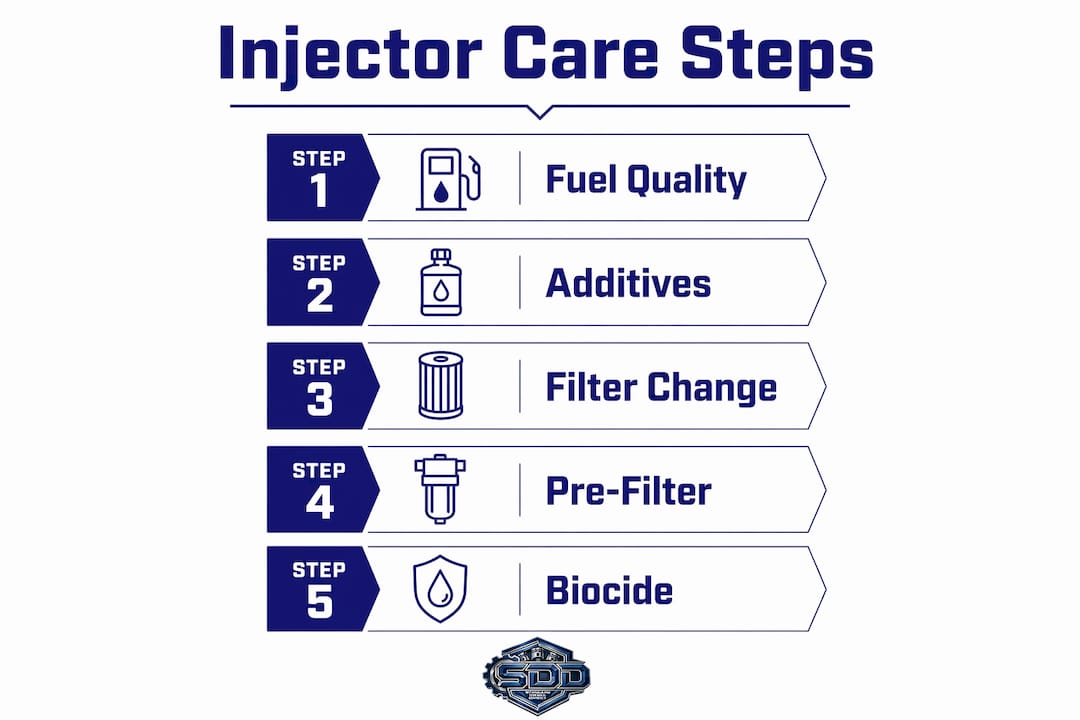
Use high-quality diesel from reputable sources
Buy diesel from high-volume stations with rapid fuel turnover. Fuel that sits in underground tanks for weeks accumulates water through condensation and microbial growth. Both water and microbes destroy injector components quickly.

Add a lubricity additive to every fill-up
ULSD lacks lubricity, and adding a quality lubricity additive directly compensates for that deficiency. Many additives also improve cetane ratings, which improves combustion efficiency and reduces injector stress. This is one of the lowest-cost, highest-return steps available for extending injector life.
Pro Tip: Look for additives that list lubricity improvement and cetane boost on the label. Avoid products that only claim to clean injectors without addressing lubricity.
Replace fuel filters on schedule
The table below shows general replacement intervals based on operating conditions. Always follow your OEM specification first, then adjust based on environment.
| Operating Condition | Recommended Filter Interval |
|---|---|
| Normal highway use | Every 15,000–25,000 miles |
| Dusty or off-road environments | Every 10,000 miles |
| Biodiesel blends (B20 and above) | Every 10,000 miles |
| Contamination event or water ingestion | Immediately |
Fuel filters must meet or exceed OEM cleanliness standards because particles under 10 microns cause destructive injector wear. A filter that looks clean on the outside can still be passing harmful contaminants.
Install a pre-filter upstream of the factory filter
Installing an extra pre-filter before the factory fuel filter catches larger contaminants and water before they reach the primary filter. Mount the pre-filter away from engine heat sources to prevent fuel breakdown. This two-stage approach protects the factory filter and extends its service life significantly.
Treat fuel with biocide when needed
Microbial growth in diesel tanks produces a dark, slimy contamination called diesel bug. It clogs filters rapidly and introduces organic acids that corrode injector components. Biocide treatments kill active microbial colonies and prevent regrowth, particularly in trucks that sit unused for extended periods.
What are the signs of failing diesel injectors?
Recognizing signs of injector failure early is the difference between a filter change and a $3,000–$10,000 repair bill. Faulty injectors cause 20–40% fuel economy loss overnight, and that drop is one of the clearest early warning signals available.
Watch for these symptoms:
- Rough idle or engine misfires. An injector delivering too much or too little fuel disrupts the combustion cycle on that cylinder.
- Excessive black or white smoke. Black smoke indicates over-fueling; white smoke points to unburned fuel from a leaking or stuck-open injector.
- Hard starting, especially when cold. Injectors that cannot hold rail pressure allow fuel to drain back, making cold starts difficult.
- Reduced fuel economy. A measurable drop in miles per gallon without a change in driving habits is a reliable early indicator.
- Fault codes related to rail pressure or injector balance rates. These codes appear in the ECU before physical symptoms become obvious.
Pro Tip: Do not clear fault codes without recording them first. Rail pressure codes and injector balance rate codes tell you which cylinder is affected and whether the problem is electrical or mechanical.
Why idle testing alone is not enough
Back-leakage testing measures return fuel flow under load and is more reliable than idle testing for diagnosing injector faults. Significant deviation in return flow between injectors identifies defective units that perform acceptably at idle but fail under real operating conditions. Any diesel injector troubleshooting process should include a back-leakage test as standard practice.
What is the best preventive maintenance routine for diesel injectors?
A structured maintenance routine is the most reliable way to extend diesel injector life and avoid unplanned repairs. Follow these steps consistently.
-
Replace fuel filters at scheduled intervals. Use the interval table from the filtration section as your baseline. Mark filter changes in a maintenance log so nothing gets missed.
-
Inspect the fuel tank for water and sediment every 30,000 miles. Drain the water separator if your truck has one. Check the tank bottom for sludge if the truck has high mileage or sits for long periods.
-
Add a lubricity additive at every fill-up. This step costs very little and directly reduces injector wear caused by ULSD.
-
Keep the fuel tank at least half full. A fuller tank reduces the air space where condensation forms. Less condensation means less water contamination and less microbial growth.
-
Avoid extended engine inactivity. Diesel that sits in injectors for weeks degrades and leaves deposits. If the truck will sit for more than a month, add a fuel stabilizer and run the engine briefly to circulate treated fuel through the system.
-
Flush the fuel system after any contamination event. If water, debris, or microbial contamination enters the system, a flush is not optional. Contaminated fuel left in the system will damage new filters and injectors quickly.
-
Schedule a professional diagnostic check annually. A technician with access to live rail pressure data and injector balance rates can spot developing problems before they become failures.
Pro Tip: When you replace injectors, always perform a fuel system flush first and have the new injectors trim-coded to the ECU. Skipping trim coding causes uneven fuel delivery and can destroy new injectors within a short period.
The comparison below shows the difference between reactive and preventive maintenance approaches over a typical ownership period.
| Approach | Typical Cost Range | Injector Lifespan Outcome |
|---|---|---|
| Reactive (fix when broken) | $3,000–$10,000 per event | 100,000 miles or less |
| Preventive (scheduled care) | $200–$600 per year | 150,000–200,000 miles |
Common mistakes that cause injector damage
Most injector failures are preventable. The mistakes below are the most common reasons diesel owners end up with a large repair bill.
- Ignoring fault codes. Ignoring fuel system fault codes leads to repeated injector failures and escalating repair costs. A code is the ECU telling you something is wrong before the damage becomes catastrophic.
- Delaying filter changes. A clogged filter forces the lift pump to work harder and allows contaminated fuel to bypass the filter media. Both outcomes accelerate injector wear.
- Skipping biocide treatments. Diesel bug grows fast in warm weather and in tanks that sit unused. A single biocide treatment costs a fraction of a filter replacement.
- Replacing injectors without flushing the system. New injectors require a full system flush and ECU trim coding to deliver even fuel distribution. Installing new injectors into a contaminated system guarantees early failure.
- Relying on quick-fix additives after failure has started. Cleaning additives support healthy injectors but cannot reverse mechanical wear or remove heavy deposits from damaged components.
Proper injector calibration, called trim coding, programs the ECU with the flow characteristics of each new injector. Without it, the engine cannot compensate for manufacturing tolerances between units, and fuel delivery becomes uneven across cylinders.
Standard Diesel Direct fuel system upgrades for injector protection
Standard Diesel Direct carries FASS Titanium Signature Series fuel systems designed to deliver clean, water-free, air-free fuel to your injectors at consistent pressure. These systems add a high-efficiency filtration stage that goes well beyond what the factory setup provides.
For Dodge Cummins owners, the FASS Titanium Signature Series is a direct upgrade that removes water and air from the fuel supply before it reaches your injectors. Ford Powerstroke owners can find a matched system in the Titanium Signature Series Plus for 6.4L applications. Investing in a quality fuel system now costs far less than replacing a set of injectors later. Standard Diesel Direct stocks fitment-specific options for Cummins, Duramax, and Powerstroke platforms so you can find the right system for your truck without guesswork on compatibility.
Key takeaways
Consistent fuel quality management, proper filtration, and scheduled maintenance are the three factors that determine whether diesel injectors reach 200,000 miles or fail before 100,000.
| Point | Details |
|---|---|
| Fuel quality drives injector life | Use high-volume stations and add a lubricity additive at every fill-up to compensate for ULSD limitations. |
| Filtration is your first line of defense | Replace filters on schedule and install a pre-filter upstream to catch water and large particles early. |
| Early symptoms signal real problems | Rough idle, smoke, and fuel economy drops are injector warning signs that require immediate diagnostic attention. |
| Back-leakage testing beats idle testing | Measure return fuel flow under load to identify failing injectors that perform normally at idle. |
| System flush and trim coding are non-negotiable | Always flush the fuel system and trim-code new injectors to the ECU to avoid immediate repeat failures. |
FAQ
How often should diesel injectors be replaced?
Diesel injectors typically last 100,000 to 200,000 miles with proper maintenance. Neglecting fuel quality and filter changes can cut that lifespan significantly shorter.
What is the most common cause of diesel injector failure?
Fuel contamination from microscopic particles and water is the leading cause. Particles as small as 2–8 microns cause severe wear on injector needles and valves under high operating pressure.
Can fuel additives really protect diesel injectors?
Yes. Lubricity additives directly compensate for the reduced lubrication in ULSD fuel and extend injector service life. They work best as a preventive measure, not as a repair solution after damage has started.
How do I know if my diesel injectors are failing?
The clearest signs of injector failure include rough idle, excessive black or white smoke, hard cold starts, and a noticeable drop in fuel economy. Fault codes related to rail pressure or injector balance rates often appear before physical symptoms become obvious.
What is trim coding and why does it matter?
Trim coding programs the ECU with the specific flow characteristics of each replacement injector. Without it, fuel delivery becomes uneven across cylinders, which causes rough running and can damage the new injectors quickly.
Recommended
- How to Install Diesel Performance Injectors: Full Guide – Standard Diesel Direct
- FASS Titanium Signature Series Diesel Fuel System 180F 140GPH at 45PSI – Standard Diesel Direct
- FASS Titanium Signature Series Diesel Fuel System 290F 260GPH at 45PSI – Standard Diesel Direct
- FASS No Drop Series Diesel Fuel System for 2005-2018/2021-2023 Dodge R – Standard Diesel Direct