

For most F-250 owners, the right move is a high-quality single aftermarket stabilizer to replace the weak factory unit. Step up to a dual kit only when you’re running a significant lift or 35"+ tires. Before you order anything, run three quick checks: inspect your steering linkages for play, verify your caster is near +4° positive, and check whether your truck falls under Ford’s steering-oscillation warranty coverage. Standard Diesel Direct carries fitment-specific options for 2005–2024 Super Duty trucks, so you can confirm compatibility before you buy.
-
Inspect tie rod ends, drag link, and track bar for looseness before purchasing any stabilizer.
-
Confirm caster is near +4° positive — a stabilizer on a truck with incorrect caster is a temporary fix at best.
-
Check Ford’s service history for steering-oscillation TSBs on your model year.
Key Takeaways
A quality single stabilizer handles most F-250 steering issues; move to a dual kit only after confirming your lift, tire size, and steering components genuinely require it.
| Point | Details |
|---|---|
| Inspect before you buy | Check tie rods, track bar, drag link, and caster before ordering any stabilizer. |
| Single vs dual decision | Single replacement suits stock to mildly lifted trucks; dual kits are for 35"+ tires or lifts of 3 inches or more. |
| Caster matters | Target approximately +4° positive caster; a stabilizer on a truck with incorrect caster is a temporary fix. |
| Dual kits stress worn parts | Dual stabilizers increase forces on rod ends; replace worn linkage before installing a dual kit. |
| Standard Diesel Direct fitment | Kryptonite dual kits and Fox 2.0 single stabilizers for 2005–2024 Super Duty trucks are available with vehicle-specific fitment support. |
What are the best steering stabilizer upgrade options for your F-250?
For stock or mildly modified Super Duty trucks, a quality single-replacement stabilizer handles the job well. The factory unit uses a thin rod diameter and light valving that wears quickly, especially on trucks that see gravel roads, heavy towing, or uneven pavement. Upgrading to a larger-bore, gas-charged unit with stiffer valving noticeably tightens steering feel and reduces the vague, wandering sensation many F-250 owners describe at highway speeds.
When you add a lift of 3 inches or more, or mount tires larger than 35 inches, the geometry changes enough that a single stabilizer struggles to keep up. That’s where a dual steering stabilizer kit earns its place. According to BDS Suspension, upgrading to a larger-capacity single or dual stabilizer increases damping force, and dual kits effectively double the available damping for lifted trucks.
Recommended options from Standard Diesel Direct:
-
Kryptonite Death Grip Dual Stabilizer Kit (2005–2024 F-250/F-350): Heavy-duty construction with a larger rod diameter than OE, designed for trucks with lifts and oversized tires. Includes all mounting hardware and fits 4WD Super Duty applications.
-
Fox 2.0 Performance Series Single Stabilizer (2008–2024 F-250/F-350): A Fox 2.0 single stabilizer with internal floating piston design and nitrogen charge. Best for stock-height or mildly lifted daily drivers who want a direct OE replacement with noticeably better damping.
-
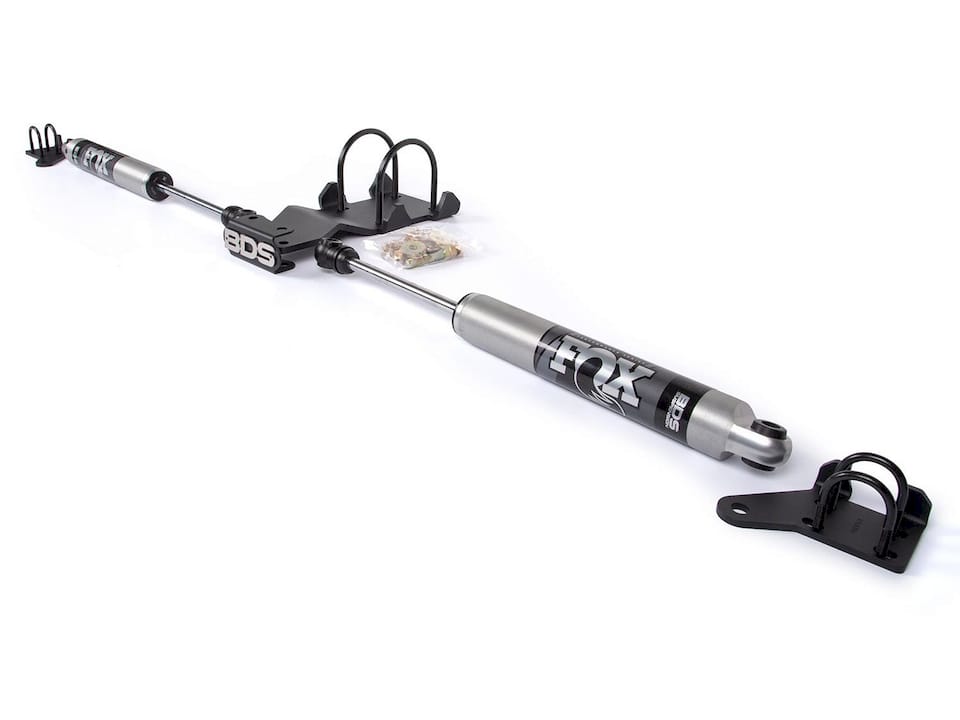
BDS Dual Kit with Fox 2.0 Shocks (2005–2026 F-250/F-350 4WD): BDS documents fitment windows for 0–2" and 2.5–9" lift ranges, with FOX 2.0 or NX2 cylinder options depending on lift height.
Fitment notes:
-
All options above are 4WD-specific. Two-wheel-drive F-250s use a different steering geometry and typically require a different bracket configuration.
-
Trucks with aftermarket differential covers (Mag-Hytec-style) may need clearance verification before ordering a center-mount dual kit. More on that in the installation section.
-
Model years 2005–2010 and 2011–2016 use slightly different drag link geometry; confirm the kit specifies your year range.
Pro Tip: Match your stabilizer valving to your shock upgrade. If you’ve already installed stiffer shocks and larger tires, a lightly valved stabilizer will feel underdamped. Go with a firmer-valved unit or a dual kit to keep steering response proportional to the rest of your suspension.
What does a steering stabilizer actually do — and what it won’t fix
A steering stabilizer is a hydraulic damper cylinder mounted between the steering linkage and the axle or frame. It absorbs rapid, high-frequency inputs — road vibration, bump steer, and steering wheel kick — and converts that energy into heat. The result is a calmer, more controlled steering feel, particularly on rough surfaces or at highway speeds.
What it cannot do is equally important to understand.
A steering stabilizer is a damping device, not a structural repair. It will not correct worn tie rod ends, a loose track bar, incorrect caster, or a failing ball joint. Installing one over damaged components may temporarily mask symptoms while those components continue to wear — and that creates a safety risk, not a solution.
A single stabilizer applies damping force in one axis. A dual opposed setup places two cylinders on opposite sides of the drag link, creating a self-canceling pressure system that resists bump steer from both directions. The result is more total damping force and better resistance to the oscillation that large tires and lifted geometry amplify. BDS Suspension confirms that dual kits effectively double available damping compared to a single unit.
The “death wobble” misconception deserves a direct answer: a stabilizer does not fix death wobble. Death wobble is a resonance event caused by worn or loose steering components, incorrect caster, or both. A stabilizer may delay the onset or reduce severity, but the underlying cause remains. Fix the geometry and components first. The stabilizer is the last step.
What to inspect before you buy or install anything
Running this checklist before ordering saves you from installing a stabilizer that can’t do its job — or worse, one that hides a dangerous wear condition.
-
Tie rod ends and drag link: Grab each end and check for vertical and horizontal play. Any detectable movement means replacement before a stabilizer goes on.
-
Track bar: Check both ends for bushing wear and bolt torque. A loose track bar is one of the most common contributors to death wobble on Super Duty trucks.
-
Pitman arm: Check for looseness at the steering box output shaft. Worn splines here cause vague, unpredictable steering.
-
Ball joints: Check upper and lower for play using a pry bar under the tire. Most F-250 ball joints have a wear indicator; check it.
-
Control arm bushings: Look for cracking or deflection. Worn bushings allow the axle to shift under load.
-
Caster angle: Have a shop measure it. Guides consistently recommend targeting approximately +4° positive caster for stable, self-centering steering on Super Duty trucks. If caster is off, correct it before installing a stabilizer.
-
Wheel balance and tires: An out-of-balance tire creates exactly the kind of oscillation a stabilizer is blamed for. Balance first.
Simple road test: Remove the existing stabilizer and drive the truck at 45–55 mph on a smooth road. If the steering is dramatically worse without it, the stabilizer was masking a real problem. Diagnose and repair that problem before reinstalling.
What a DIY can handle in a day: visual inspection of all linkage components, pry-bar play checks, wheel balance verification, and stabilizer removal/road test. Caster measurement and correction, track bar replacement, and ball joint replacement typically require a shop with an alignment rack.
Rough cost expectations for common repairs: tie rod ends run $150–$400 in parts depending on brand and whether you replace the full assembly; track bar replacement is $100–$300 in parts; a full alignment with caster correction runs $150–$250 at most shops. These are general ranges — actual costs vary by region and shop rate.
How to install a steering stabilizer: tools, time, and what can go wrong
Most single-stabilizer swaps are straightforward bolt-on jobs. Dual kits add a bracket and a second cylinder but remain DIY-friendly for anyone comfortable with basic suspension work.
Tools you’ll need:
-
Combination wrench set and socket set (metric and SAE)
-
Torque wrench (capable of 50–80 ft-lbs for most mounting hardware)
-
Jack stands and a floor jack
-
Pry bar for alignment during install
-
Thread-locking compound (blue Loctite) for bracket bolts
Time estimates: A single stabilizer swap takes 30–60 minutes for a competent DIY. A dual kit with new brackets runs 1.5–3 hours. A shop will typically charge 1–2 hours of labor for either job.
Alignment after install: A stabilizer swap alone does not require a full alignment. However, if you corrected caster or replaced the track bar during the same service, get a full alignment before driving. A toe-only check is sufficient if the only change was the stabilizer itself.
Common pitfalls to avoid:
-
Differential cover interference: Center-mount dual kits can contact aftermarket differential covers. PMF Suspension’s dual kit documentation specifically notes that some aftermarket covers require minor modification for clearance. Measure before you order.
-
Stabilizer bottoming out: After install, have an assistant turn the wheel lock-to-lock while you watch the stabilizer. It must never reach full compression or full extension through the entire steering range. A bottomed stabilizer binds steering and can damage the cylinder.
-
Mounting hardware torque: Under-torqued brackets allow the stabilizer to shift under load, creating noise and accelerating wear at the mounting points. Follow the torque specs in your product documentation.
-
Shock length mismatch on lifted trucks: If your lift height doesn’t match the kit’s specified range, the stabilizer may bind at full droop or full compression. Confirm lift height before purchasing.
Should you choose a single replacement or a dual stabilizer kit?
The right choice depends on how your truck is set up and how you use it.
A single high-quality replacement is the better choice when:
-
Your truck is stock height or has a mild lift under 3 inches.
-
You’re running factory-size tires or up to 33 inches.
-
Towing is your primary use case — dual kits add steering resistance that can feel heavy during low-speed maneuvering with a trailer.
-
You want a direct, cost-effective upgrade without additional hardware complexity.
A dual kit makes sense when:
-
You’re running 35-inch or larger tires, where the added unsprung weight amplifies steering oscillation.
-
Your lift is 3 inches or more, which changes caster and increases the leverage forces on the drag link.
-
You use the truck for aggressive off-road driving where large bump inputs are frequent.
-
You’ve already addressed all worn steering components and want maximum damping.
| Truck Setup | Recommended Option | Expected Benefit | Caution |
|---|---|---|---|
| Stock daily driver | Quality single replacement | Reduced highway wander, firmer feel | Confirm OE components are in good condition |
| Mild lift, 33" tires | Quality single or entry dual | Improved control on rough roads | Check caster before install |
| Heavy lift, 35"+ tires | Dual stabilizer kit | Maximum damping, reduced oscillation | Inspect all linkage; dual kits stress worn parts |
| Dedicated off-road rig | Dual stabilizer kit | Best bump-steer resistance | Expect increased steering effort on-road |
One trade-off worth understanding: dual kits concentrate resistive forces on the drag link and tie rod ends. Ford-trucks confirms that running dual stabilizers on worn components accelerates wear at rod ends. Dual kits are not a shortcut around proper maintenance.
Expert-level checks to confirm a stabilizer upgrade will actually help
This protocol is for advanced DIYers and shop technicians who want to verify the diagnosis before spending money on parts.
-
Baseline road test with notes: Drive at 45–65 mph and document steering behavior — pull, wander, oscillation onset speed, and return-to-center feel. This gives you a before/after comparison.
-
Remove the existing stabilizer and repeat the road test: If behavior is identical, the stabilizer was doing nothing. If it’s dramatically worse, something in the steering is worn and was being masked.
-
Measure free play at the steering wheel: With the truck on the ground and wheels straight, measure how far the wheel turns before the tires move. More than 1.5–2 inches of free play at the wheel rim typically indicates worn linkage or a loose steering box.
-
Check caster with an alignment gauge or at a shop: Target approximately +4° positive caster. Trucks with less than +3° will fight you regardless of what stabilizer you install.
-
Inspect return-to-center behavior: After a turn, release the wheel. A properly set-up truck returns to center on its own. One that doesn’t has a caster or linkage problem, not a stabilizer problem.
Safety callouts:
-
Never use a stabilizer to suppress active death wobble. Death wobble indicates a resonance failure in the steering system. Drive slowly to a shop; do not mask it with a stiffer damper.
-
Dual kits on trucks with worn rod ends will accelerate component failure. Replace worn parts first, every time.
Pro Tip: Stage your upgrades in this order for the best result and least wasted money: (1) repair any worn geometry or linkage, (2) correct caster if needed, (3) upgrade shocks and tires if planned, (4) install the stabilizer last. Skipping steps doesn’t save money — it usually means buying parts twice.
Standard Diesel Direct has your F-250 steering upgrade covered
Standard Diesel Direct stocks vehicle-specific Kryptonite dual stabilizer kits and Fox 2.0 single stabilizer options matched to Ford Super Duty model years, so you’re not guessing at fitment. Every kit ships with the hardware needed for installation, and the product pages include lift-range compatibility details to confirm the right choice for your setup.
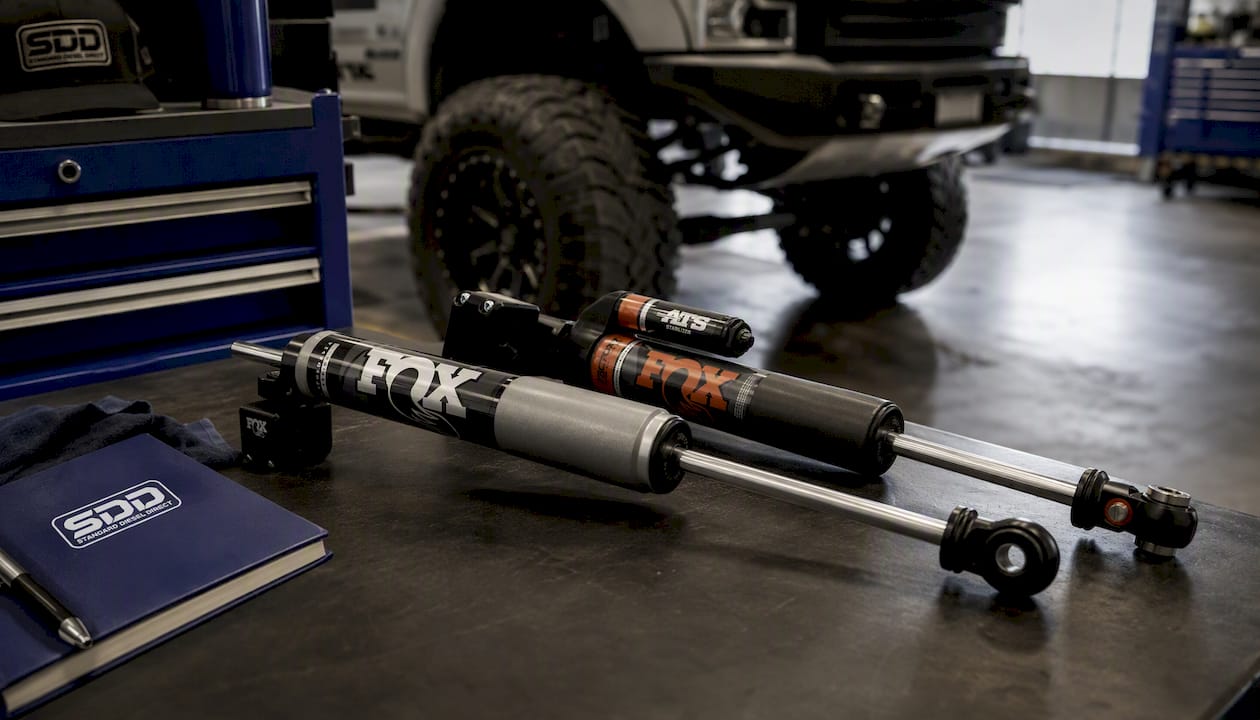
If you want to customize your order — add an adapter kit, swap hardware, or bundle with other suspension components — Standard Diesel Direct’s item customizations option at checkout lets you tailor the order to your exact build. The team is available to answer fitment questions before you buy, which matters when you’re deciding between a single Fox 2.0 and a full Kryptonite dual kit for a lifted rig.
Head to the Standard Diesel Direct product pages to confirm fitment for your year and lift height, and get the right stabilizer shipped directly to your door.
Sources
FAQ
What does a steering stabilizer do on an F-250?
A steering stabilizer is a hydraulic damper that absorbs rapid steering inputs and wheel oscillation, reducing the vague or wandering feel common on Super Duty trucks. It does not correct worn components or alignment issues.
How do you get rid of death wobble on an F-250?
Death wobble requires diagnosing and repairing the root cause: inspect tie rod ends, track bar, drag link, and caster angle, targeting approximately +4° positive caster. A steering stabilizer alone will not eliminate death wobble.
Does a steering stabilizer make a noticeable difference?
Yes, particularly on trucks with worn factory dampers, oversized tires, or lifted suspensions. Owner reports consistently show that a quality single stabilizer reduces highway wander on lightly modified trucks, while dual kits deliver the most benefit on rigs with 35"+ tires.
How can you make an F-250 ride and steer smoother?
The most effective approach combines proper caster alignment, quality shocks, correct tire pressure for your load, and a steering stabilizer upgrade installed last. A stabilizer alone rarely transforms steering feel if the underlying geometry and components are not in good condition first.
Recommended
-
Kryptonite 2005-2024 F-250 / F-350 SD Dual Steering Stabilizer Kit – Standard Diesel Direct
-
FOX PERFORMANCE SERIES 2.0 TS STABILIZER - FORD SUPER DUTY 2017-2024 – Standard Diesel Direct
-
Fox Performance Series 2.0 Ts Stabilizer - Ram Truck 2500/3500 2014-20 – Standard Diesel Direct
-
Kryptonite Ford Super Duty F250/f350 Death Grip Dual Steering Stabiliz – Standard Diesel Direct