

If your Duramax 2500 or 3500 HD feels loose in the steering or wanders under load, the fix in most cases is a heavy-duty tie rod assembly with greaseable joints and forged construction, not a budget sleeve kit. Buy the correct fitment kit for your model year, then schedule a professional alignment (or prep your own toe-check tools if you’re doing it yourself).
Two things drive that recommendation:
-
Worn tie rods usually fail through ball-stud wear or a buckled shaft under load, not sudden breakage, so symptoms build slowly before they get dangerous.
-
Steering feel depends on more than tie rods. Tire condition, pressure, and alignment all factor into how “tight” your truck feels on the road.
Key Takeaways
A heavy-duty tie rod assembly with greaseable joints and forged construction outlasts sleeves and OEM parts under towing loads, but only delivers full value alongside a professional alignment.
| Point | Details |
|---|---|
| Choose HD for heavy use | Full HD assemblies suit towing, big tires, and repeated high-load driving; sleeves suit light use only. |
| Confirm your center link | 2001 to 2010 and 2011 to 2026 Duramax HD trucks use different steering geometry, so match your kit accordingly. |
| Budget real install time | Pitman arm and steering gearbox removal often slow the job down and may need a dedicated puller. |
| Alignment is not optional | A professional toe alignment after tie rod replacement prevents uneven tire wear and validates the job. |
| Standard Diesel Direct’s pick | Kryptonite-style HD assemblies with greaseable joints and rebuild kit availability lead the publisher’s recommended shortlist. |
Where to Find Fitment Guides, Manuals, and Community Experience
For model-specific edge cases, like unusual steering symptoms or lift clearance questions, community threads on DuramaxForum offer real owner troubleshooting that manufacturer manuals don’t cover.
-
Forum threads on steering sensitivity and bump steer often reveal fitment quirks specific to certain model years.
-
Manufacturer installation guides confirm torque specs and grease fitting locations.
HD Tie Rods vs Sleeves vs OEM Replacement: Which Fits Your Truck?
Three upgrade paths exist for a Duramax steering system, and each solves a different problem. A full heavy-duty tie rod assembly replaces the inner and outer rod ends completely with a forged, larger-diameter unit built for repeated high-load use. A sleeve kit wraps or reinforces the factory tie rod ends without replacing the whole assembly, which keeps cost down but leaves you with the original design’s weak points intact. OEM replacement rods simply restore stock geometry and stock strength, nothing more.
Forum consensus on this is consistent: sleeves are a pragmatic, lower-cost fix for trucks with light use, while full HD assemblies earn their price on trucks that tow heavy, run larger tires, or see repeated high-load driving, according to owner discussions comparing HD tie rods to sleeves.
| Best for | Upgrade scope | Serviceability | Durability |
|---|---|---|---|
| Daily driver, light towing | OEM replacement | Sealed, non-greaseable | Stock-level strength |
| Budget fix, occasional towing | Sleeve over OEM ends | Sealed, non-greaseable | Moderate improvement |
| Heavy towing, big tires, sled pulling | Full HD assembly | Greaseable, rebuildable | Forged, larger shaft diameter |
When you’re evaluating specific kits, check these features before you buy:
-
Greaseable ball joints (lets you flush contamination instead of replacing the whole part).
-
Forged chromoly or comparable steel construction, not cast.
-
Stud and shaft diameter compared to OEM specs.
-
Warranty terms and whether a rebuild kit is sold separately.
Which Model Years and Center Links Should You Confirm?
Duramax 2500 and 3500 HD trucks split into two major steering generations, and mixing parts between them is the single most common fitment mistake. Confirm which family your truck falls into before you order anything.
-
Trucks built 2001 through 2010 use a different inner tie rod design and center link geometry than 2011 and newer trucks.
-
2011 through 2026 HD trucks share a common center link footprint, but some HD tie rod kits require confirming whether your truck has the standard center link or a service replacement already installed.
-
Lifted trucks need extra scrutiny. Larger-diameter HD tie rods can contact sway bar links or bump stops on certain aftermarket lift systems, so check clearance specs before installing, particularly on trucks running kits from lift manufacturers with non-stock steering geometry.
-
If you’re buying online or over the phone, photograph your current center link and inner tie rod mounting points, and have your VIN and exact trim on hand.
Pro Tip: A fitment chart only tells you the model year range. Cross-check it against your actual center link part number stamped on the part itself. Two trucks built a year apart can carry different center links after a dealer service replacement.
What Does a Tie Rod Upgrade Install Actually Involve?
Budget more time than you’d expect. Forum installation threads consistently flag the pitman arm and steering gearbox as the parts most likely to fight you, often requiring a dedicated puller and patience to avoid damaging seals or rotating the steering wheel out of position, according to installation threads on Duramax tie rod swaps.
Tools you’ll need:
-
Tie rod puller (pickle fork works, but a proper puller is gentler on boots).
-
Torque wrench rated for the specs on your kit’s instructions.
-
Grease gun, for greaseable joints.
-
Snap-ring pliers or a punch, depending on your kit’s hardware.
-
Pitman arm puller, if you’re removing the steering gearbox.
General install order:
-
Support the truck properly on jack stands, then mark your steering wheel’s centered position before touching anything.
-
Separate the inner tie rod from the center link first, then swap the outer, torquing to spec as you go.
-
Install grease fittings if your kit doesn’t ship with them preinstalled.
-
Do a rough toe-in check before the truck leaves your driveway or bay.
Watch for a stubborn pitman arm, unexpected clearance issues on lifted trucks, and the temptation to skip recording your drag link orientation before disassembly. That last one turns a two-hour job into a four-hour guessing game.
What Should You Inspect Before and After the Upgrade?
New tie rods rarely deliver their full benefit if worn parts around them go unaddressed. Before you call the job done, walk through the rest of the steering linkage.
-
Pitman arm: check for play at the ball stud and cracks near the mounting spline.
-
Idler arm: wiggle-test for excess movement, a common source of wander that gets blamed on tie rods.
-
Center link: inspect for bending or worn tie rod sockets.
-
Steering stabilizer: confirm it’s not leaking or bottoming out.
-
Steering gearbox and intermediate shaft: check for lash or looseness at the input shaft.
A professional toe alignment is required after any tie rod replacement, full stop. Skipping it leaves you guessing at toe specs and burns tires unevenly within a few thousand miles. After the alignment, take a test drive on a straight, flat road and confirm the wheel is centered and the truck tracks without pulling.
Pro Tip: If you’re still feeling bump steer or road vibration after the alignment, check your steering stabilizer part number against your truck’s build. Owners consistently report that a properly matched stabilizer, sometimes a dual setup, cuts bump steer that persists even with new tie rods installed, according to reports on 2500HD bump steer.
How Do You Keep Upgraded Tie Rods Lasting Longer?
Greaseable joints only pay off if you actually grease them. Set a service interval and stick to it, especially if you tow regularly or run off-pavement.
-
Grease every 3,000 to 5,000 miles, or per your kit manufacturer’s schedule, whichever is more conservative.
-
Watch for torn boots, which let contamination into the joint and accelerate wear far faster than mileage alone would suggest.
-
Rebuild kits matter more than they sound. A sealed assembly gets thrown away the day a single ball joint wears out; a serviceable HD assembly with a rebuild kit available lets you replace just the worn component, according to BDS Suspension’s product specs on greaseable HD tie rod kits.
Before buying, check for a lifetime or limited warranty, a clear returns policy, and a downloadable installation manual. Kits that skip the manual usually skip the fitment detail you need too.
Why We Recommend the Kryptonite-Style HD Assembly
Standard Diesel Direct points customers toward Kryptonite-style heavy-duty assemblies for one straightforward reason: larger shaft and stud diameters combined with forged construction hold up under repeated high-load cycles better than stock-geometry parts, greaseable or not.
-
Forged chromoly construction resists the buckling that ends most stock tie rods’ service life.
-
Greaseable joints mean you’re maintaining the part, not replacing the whole assembly at the first sign of wear.
-
Rebuild kits are sold separately, which keeps long-term cost down.
One caveat worth flagging honestly: some lift kits, including certain Fabtech and McGaughys setups, change center link geometry or ride height enough to affect clearance. Confirm compatibility before ordering, particularly for Kryptonite tie rods built for Fabtech RTS lift kits.
Pro Tip: Keep a spare set of OEM tie rod ends in your truck’s toolbox if you’re running HD parts on a work rig. HD replacements aren’t always sitting on a shelf at every parts counter, and a stock-fit emergency swap can get you home.
What Does a Tie Rod Upgrade Actually Cost?
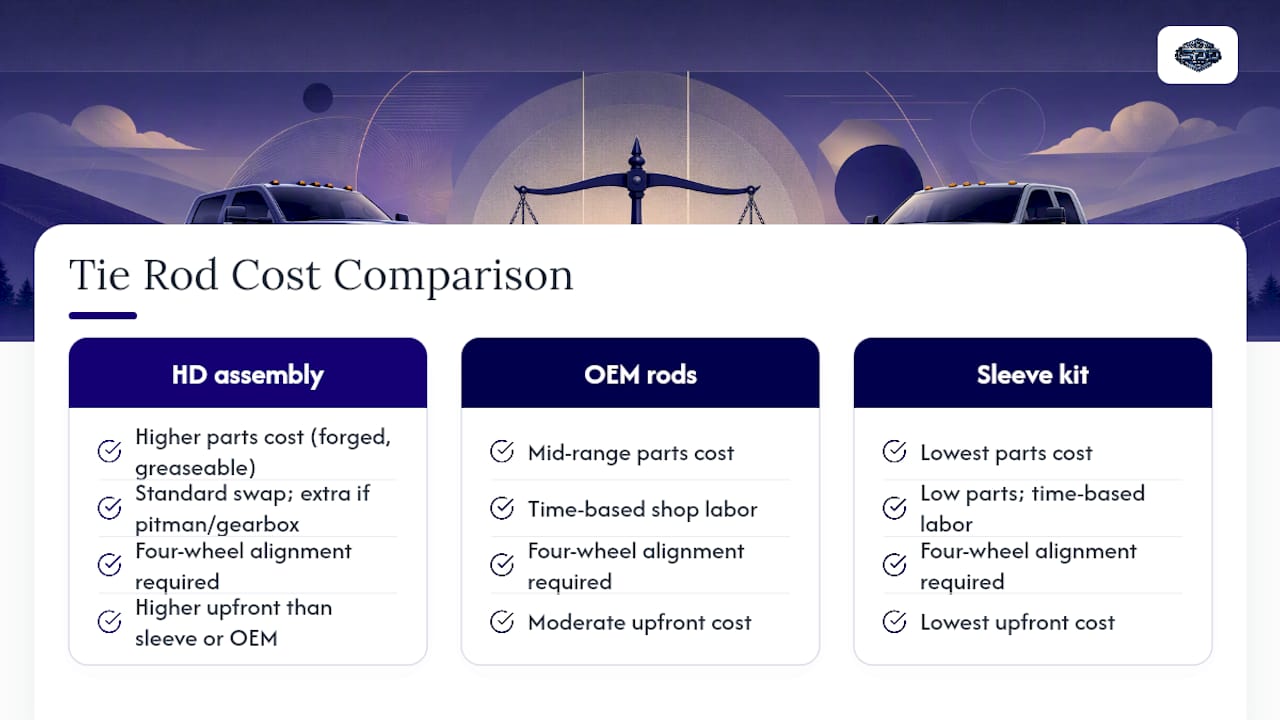
A full HD tie rod assembly for a Duramax 2500 or 3500 typically runs higher upfront than a sleeve kit or OEM replacement, but the math changes once you factor in labor and how often you’re replacing parts.
Parts cost. A complete inner and outer HD assembly costs more than a basic OEM pair, largely due to the forged materials and greaseable hardware. Rebuild kits and grease fittings, if not included, add a modest amount on top. Sleeve kits sit at the low end of the price range, and OEM replacement rods land in the middle.
Labor cost. If you’re paying a shop, expect the bulk of the labor charge to reflect time, not parts markup. A straightforward tie rod swap without pitman arm or gearbox removal runs on the shorter end. Add the pitman arm, steering gearbox work, or a lifted truck’s extra clearance troubleshooting, and labor time climbs accordingly, particularly given how often forum threads flag the pitman arm as the sticking point in these jobs.
Alignment. Budget for a professional four-wheel alignment every time you replace tie rods. This isn’t optional, and skipping it to save money is the fastest way to turn a steering upgrade into a tire replacement bill a few months later.
Total investment. Add parts, labor (if you’re not doing it yourself), and alignment together, and a full HD upgrade on a 2500 or 3500 typically costs noticeably more than a sleeve-only fix upfront. Owners who tow heavy or run big tires generally report it pays for itself by avoiding repeat repairs down the line.
Order the Right Kit and Get Back on the Road
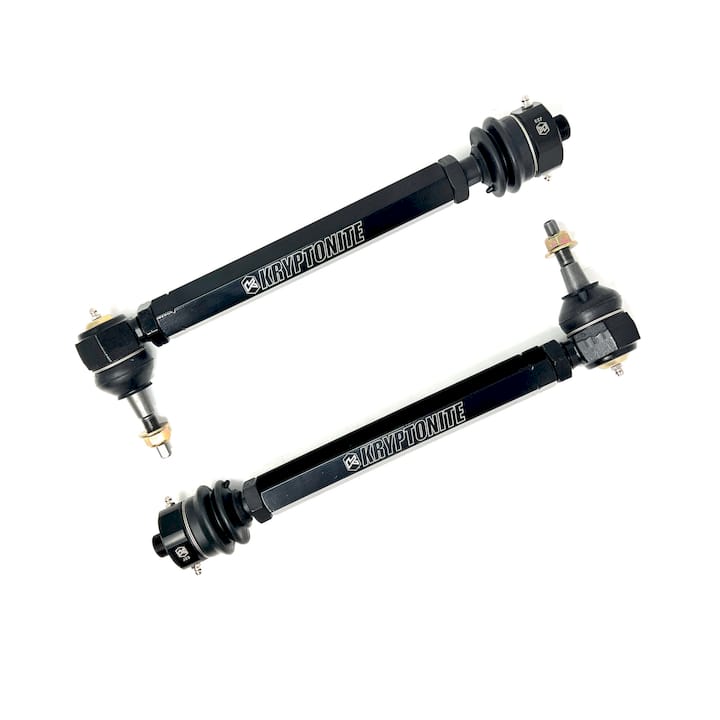
Once you know your model year and center link type, ordering is the easy part. Standard Diesel Direct carries Kryptonite Death Grip tie rod ends for 2007 to 2013 trucks and a 2014 to 2019 version for owners in the newer HD generation, plus a rebuild kit for stock center link trucks from 2011 to 2024 if you’d rather refresh what you already own instead of replacing the whole assembly.
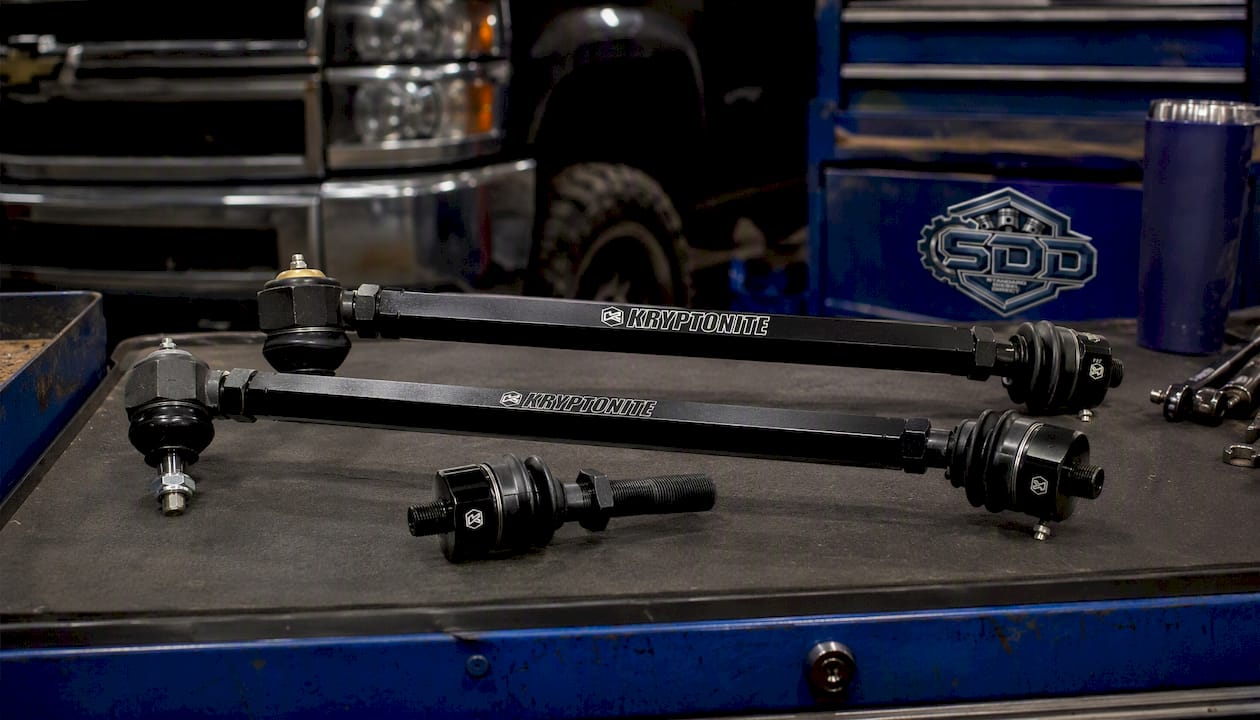
Before you check out, use the item customization options to confirm you’re getting the right grease fittings and hardware for your kit, and keep a photo of your center link handy in case a support call comes up. Standard Diesel Direct ships with clear fitment notes on every product page, so you’re not left guessing whether a kit matches your 2500 or 3500. Save your receipt and packaging until the alignment is done and you’ve driven a few hundred miles. That’s the window where a fitment mismatch or defective part typically shows up, and it’s what a warranty claim will ask for.
If a tie rod upgrade is one of several projects on your list this year, it’s worth checking which truck upgrades are actually worth the money before you spend on all of them at once. Order your fitment-correct kit today, and book the alignment appointment before the parts even arrive.
FAQ
Do Upgraded Tie Rods Actually Make a Difference?
Yes, particularly for trucks that tow heavy or run larger tires, since forged HD assemblies resist the buckling and ball-stud wear that shorten stock tie rod life. Steering feel also depends on tire condition, pressure, and alignment, so a tie rod upgrade alone won’t fix every steering complaint.
What Are the Best Tie Rods for a Duramax Truck?
For most 2500 and 3500 HD owners, a full heavy-duty assembly with greaseable joints and forged construction, like the Kryptonite-style kits Standard Diesel Direct carries, outperforms sleeve kits for towing and high-load use. Sleeves remain a reasonable budget option for light-duty daily driving.
How Do I Make My Duramax Ride Smoother?
Start with a professional alignment and correct tire pressure, since both affect steering feel as much as worn parts do. If bump steer or vibration persists after a tie rod upgrade, check your steering stabilizer part number and inspect the pitman arm, idler arm, and center link for play.
Are AC Delco Gold Tie Rods Good?
AC Delco Gold parts are OEM-spec replacements built to restore stock geometry and strength, which suits daily drivers with light towing needs. Owners running heavy loads or larger tires generally see better long-term durability from forged HD assemblies designed specifically for repeated high-stress use.
Recommended
-
Kryptonite Death Grip Tie Rods GM 2011-2019 (for Fabtech Rts Lift Kits – Standard Diesel Direct
-
Kryptonite Tie Rod Rebuild Kit For Stock Center Link 2001-2010 – Standard Diesel Direct
-
Kryptonite Replacement Left Side Tie Rod End Ford Super Duty F250/f350 – Standard Diesel Direct
-
Kryptonite Ford Super Duty Death Grip Tie Rod F-250/f-350 2005-2024 – Standard Diesel Direct