

A diesel throttle body is defined as an intake air control valve that manages airflow for emissions compliance and engine operation, not for regulating engine power. That distinction separates diesel engines from gasoline engines at a fundamental level. Most diesel owners assume the throttle body works the same way across all engines. It does not. Understanding what this component actually does, and what it does not do, helps you make better decisions about maintenance, modifications, and upgrades for your truck.
What is a diesel throttle body and how does it differ from a gasoline one?
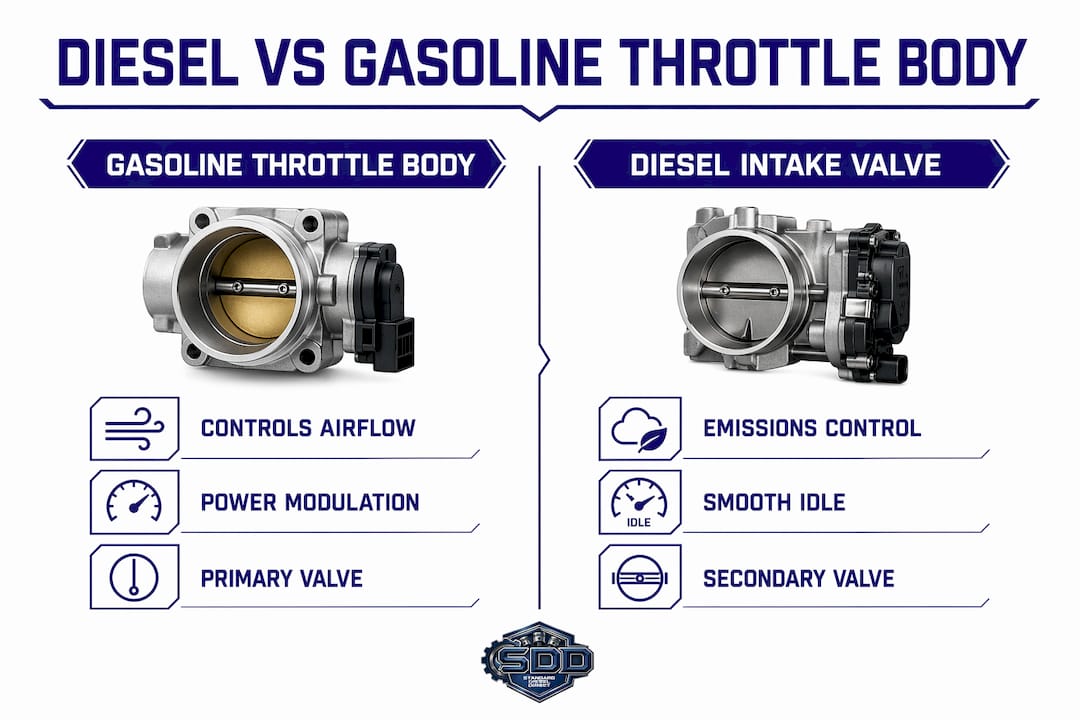
The core difference comes down to how each engine type controls power output. Gasoline engines use a throttle body to restrict airflow, which directly limits the air-fuel mixture and controls engine speed. Diesel engines do not work that way. Diesel engines regulate power by metering fuel injection quantity, not by restricting air. The engine breathes freely at all times.
Diesel compression ratios range from 16:1 to 23:1, compared to roughly 9:1 in gasoline engines. That high compression generates enough heat to ignite fuel without a spark plug. Because ignition depends on compression rather than a precise air-fuel ratio, there is no need to choke the intake. Common-rail fuel systems can reach injection pressures up to 2,500 bar, giving the ECU precise control over power output through fuel delivery alone.

Modern diesel engines do include intake throttle valves, but their purpose is narrow and specific. These valves support emissions functions, smooth engine shutdown, and idle stability. They are not throttle bodies in the traditional sense. Calling them throttle bodies is technically inaccurate, though the term is widely used in the diesel community.
| Feature | Gasoline throttle body | Diesel intake throttle valve |
|---|---|---|
| Primary function | Controls air for power regulation | Supports EGR, DPF, and shutdown |
| Power control method | Airflow restriction | Fuel injection quantity |
| Compression ratio | ~9:1 | 16:1–23:1 |
| Spark ignition required | Yes | No |
| ECU integration | Moderate | High, emissions-critical |
Pro Tip: If someone tells you to upgrade your diesel’s throttle body for more power, that advice applies to gasoline engines, not diesels. Power gains on a diesel come from the fuel system, not the intake valve.
What specific roles do diesel throttle bodies serve?
Modern diesel intake throttle valves serve several distinct functions that have nothing to do with power control. Each function ties directly to emissions compliance or engine smoothness. Here is what these valves actually do:
- EGR rate enhancement. The intake throttle valve partially closes to create a pressure differential. That differential pulls exhaust gas back into the intake through the EGR system, reducing nitrogen oxide (NOx) emissions. Without the valve restricting airflow, EGR flow rates drop significantly.
- DPF regeneration support. During diesel particulate filter (DPF) regeneration cycles, the engine needs to raise exhaust temperatures. The intake throttle valve restricts airflow to increase exhaust heat, which burns off accumulated soot in the DPF. This is a critical emissions function.
- Engine shutdown smoothing. When you turn off a diesel engine, the intake valve closes sharply to cut airflow. This stops the engine from “dieseling,” which is the rough shuddering that occurs when a diesel tries to keep running after shutdown. The valve creates a clean stop.
- Idle stability and transient response. At idle and during rapid load changes, the intake valve helps the ECU stabilize airflow. This keeps idle quality smooth and reduces hesitation during acceleration transitions.
These functions explain why diesel intake valves are emissions-critical components, not performance components. Removing or bypassing them has real consequences.
Pro Tip: The 6.7L Cummins uses what Cummins calls an “air control valve” rather than a throttle body. The name change reflects the actual function. If your truck has one, treat it as an emissions component first.
Common misconceptions about diesel throttle bodies owners should know
Misunderstanding this component leads to bad decisions. The most common mistake is treating the diesel intake valve the same as a gasoline throttle body. That misunderstanding drives owners toward modifications that create more problems than they solve.
-
Assuming the valve controls power. Many diesel owners mistake their intake valve for a power-regulating throttle body. Enlarging or replacing it does not increase horsepower. Power on a diesel comes from fuel delivery, turbocharger output, and injection timing.
-
Deleting the valve without ECU support. Removing or bypassing the intake throttle valve without addressing the ECU will trigger a Check Engine Light and disrupt emissions cycles. The ECU monitors the valve’s position and airflow feedback. When those signals disappear, fault codes follow immediately.
-
Ignoring EGR delete implications. When owners perform EGR deletes, the intake throttle valve becomes directly involved. The ECU expects the valve to assist EGR flow. Specialized bypass spacers or holding the valve in the open position electronically are required to prevent airflow faults. Skipping this step causes persistent fault codes and can impair DPF regeneration.
-
Neglecting routine maintenance. Carbon buildup on the intake throttle valve is a real issue, especially on high-mileage trucks. A dirty valve causes erratic idle, rough shutdown, and poor EGR performance. Cleaning the valve with an appropriate throttle body cleaner at regular intervals prevents these issues.
-
Assuming all diesels have the same setup. Older diesel engines, particularly pre-emissions-era trucks, often have no intake throttle valve at all. Modern diesels with EGR and DPF systems require the valve. Knowing your engine’s emissions configuration tells you whether the valve is present and what it controls.
Proper maintenance of intake airflow components protects emissions compliance and engine longevity. When symptoms appear, consult a diesel-specific technician before removing or modifying any intake valve.
How does a diesel throttle body impact performance and efficiency?
The absence of a traditional power-controlling throttle body is actually an advantage for diesel engines. Unrestricted airflow reduces pumping losses, which improves volumetric efficiency. The engine pulls in a full charge of air on every intake stroke without fighting a restriction. That is one reason diesel engines produce superior torque and better fuel economy compared to gasoline engines of similar displacement.
The intake throttle valve, when present, creates a minor restriction only during specific operating conditions. During normal driving, the valve stays fully open. The ECU only commands partial closure during EGR events, DPF regeneration, or shutdown sequences. The performance impact during normal operation is negligible.
Where performance does matter is in the fuel system. High-pressure common-rail injection at pressures up to 2,500 bar gives the ECU precise control over combustion. Fuel delivery volume, injection timing, and injection duration are the real levers for diesel performance. Upgrading the fuel system delivers measurable gains. Upgrading the intake valve does not.
| Modification | Power impact | Emissions impact | Recommended? |
|---|---|---|---|
| Intake throttle valve upgrade | Negligible | Neutral if ECU-matched | Rarely necessary |
| Fuel system upgrade | Significant | Neutral to positive | Yes, for performance builds |
| EGR delete without ECU tune | None | Negative, fault codes | Not without proper tuning |
| Throttle valve cleaning | Restores baseline | Positive, EGR function restored | Yes, routine maintenance |
The practical takeaway for diesel owners is straightforward. If you want more power, focus on the fuel system, turbocharger, and injection tuning. Electronically controlled intake throttle valves support emissions compliance and smooth operation. They are not performance bottlenecks in a properly functioning engine.
Upgrade your diesel fuel system with Standard Diesel Direct
Understanding how your diesel’s intake and fuel systems work together points directly to where real performance gains come from. The fuel system is the core of diesel power delivery, and upgrading it is the highest-impact modification you can make.

Standard Diesel Direct carries FASS Fuel Systems and the Titanium Signature Series lineup, built specifically for light-duty diesel trucks including Cummins, Duramax, and Powerstroke applications. The Titanium Signature Series Plus for 1998–2004 Dodge Cummins delivers clean, consistent fuel pressure from stock power levels up to 600 horsepower. For Ford Powerstroke owners, the Titanium Signature Series Plus for 2008–2010 6.4L addresses the fuel delivery demands of that platform directly. Standard Diesel Direct provides the technical guidance to match the right system to your build.
FAQ
Does a diesel engine have a throttle body?
Most diesel engines do not have a traditional throttle body. Modern diesels use an intake throttle valve for emissions functions like EGR and DPF support, not for controlling engine power.
What are the signs of a bad diesel throttle body?
Common signs include rough idle, erratic engine shutdown, poor EGR performance, and a Check Engine Light. Carbon buildup on the valve is the most frequent cause on high-mileage trucks.
Can you delete the throttle valve on a diesel?
Removing the intake throttle valve without proper ECU handling triggers fault codes and disrupts DPF regeneration cycles. Any delete requires a matching ECU tune or a bypass solution to prevent airflow faults.
Does upgrading the diesel throttle body add power?
No. Diesel power output is controlled by fuel injection quantity and timing, not airflow restriction. Upgrading the intake throttle valve produces no measurable power gain on a diesel engine.
How often should you clean a diesel throttle body?
Cleaning intervals depend on mileage and operating conditions, but inspecting the intake throttle valve every 30,000 miles is a reasonable starting point. Heavy towing and high-EGR applications accelerate carbon buildup.
Key takeaways
A diesel intake throttle valve manages emissions and engine smoothness, not power output. Fuel injection quantity is the only mechanism that controls diesel power.
| Point | Details |
|---|---|
| Diesel throttle body function | Intake valves support EGR flow, DPF regeneration, and engine shutdown, not power control. |
| Compression ignition advantage | Diesel compression ratios of 16:1–23:1 eliminate the need for airflow-based power regulation. |
| Fuel injection controls power | Common-rail systems at up to 2,500 bar deliver precise power control through fuel delivery alone. |
| Modification risks | Removing the intake valve without ECU support causes fault codes and disrupts emissions cycles. |
| Performance upgrade priority | Fuel system upgrades deliver real power gains; intake valve changes do not. |