

Turbo lag in diesel engines is defined as the delay between pressing the accelerator and the turbocharger delivering usable boost pressure. This delay is a physical reality rooted in diesel engine design. Exhaust gases must build sufficient pressure to spin the turbo’s turbine wheel before boost reaches the intake. Diesel engines compound this problem through lower operating RPMs and heavier internal components that resist quick acceleration. Understanding what causes this diesel turbocharger delay, and how to address it, is the difference between a truck that responds and one that hesitates at the worst possible moment.
What is turbo lag in diesel engines?
Turbo lag is the delay between initial throttle input and the turbocharger reaching its boost threshold, caused by the time required for exhaust gases to build enough pressure to spin the turbine. This is not a defect. It is a physical phenomenon built into how turbocharged engines work.
Diesel engines experience this delay more noticeably than gasoline engines for two main reasons. First, diesels operate at lower RPMs, which means less exhaust energy is available at low throttle. Second, diesel engines use heavier internal components, which increases rotational inertia throughout the drivetrain and turbo system.
The turbocharger itself must accelerate from near idle speed to tens of thousands of RPM before it can pressurize the intake. That acceleration takes time, and the gap between your foot hitting the pedal and the engine responding with full power is what drivers feel as lag. On a stock light-duty diesel truck, this delay is normal and expected. When it becomes excessive or sudden, that signals a problem worth diagnosing.
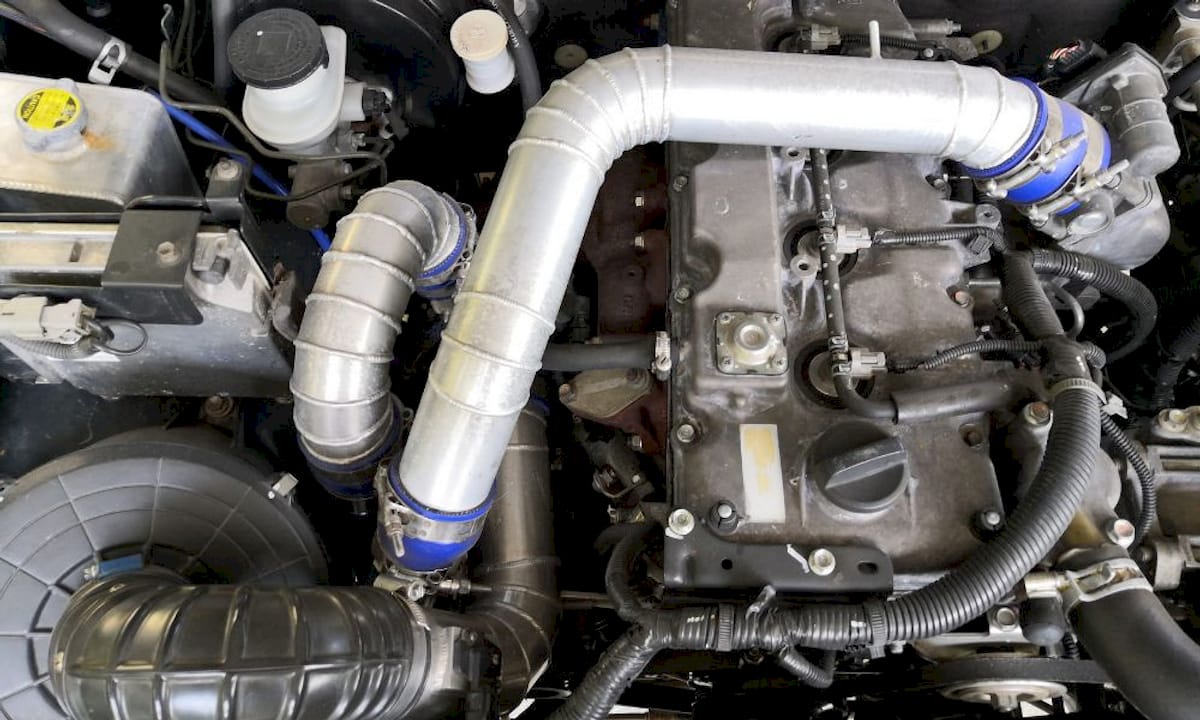
What causes turbo lag in diesel engines?
Multiple factors contribute to turbo lag, and most of them are not the turbocharger itself. Over 70% of turbo lag cases are linked to external system issues rather than turbocharger failure. That means the fix is usually simpler and cheaper than a full turbo replacement.
The most common causes include:
-
Air intake restrictions. A clogged air filter reduces the volume of air entering the engine. Less air means less combustion energy, which means less exhaust gas to drive the turbo.
-
Boost leaks. Cracked pipes or loose clamps cause significant drops in boost pressure. Even a small leak in the intercooler piping bleeds off pressurized air before it reaches the intake manifold.
-
Clogged diesel particulate filters (DPFs). A restricted DPF creates backpressure in the exhaust system. This slows exhaust flow, which directly reduces the energy available to spin the turbine.
-
Exhaust gas recirculation (EGR) issues. A malfunctioning EGR valve recirculates excessive exhaust gases into the intake, diluting the air charge and reducing combustion efficiency.
-
Worn or faulty variable geometry turbo (VGT) actuators. VGT actuators control the angle of the turbo’s vanes to manage boost at different RPMs. A stuck or sluggish actuator prevents the turbo from responding correctly to throttle inputs.
-
Fuel injector problems. Dirty or worn injectors deliver inconsistent fuel spray patterns. Poor atomization reduces combustion quality, which reduces exhaust energy and slows turbo spool time.
Pro Tip: Before spending money on turbo diagnostics, inspect every boost hose from the turbo outlet to the intake manifold. A cracked hose or loose clamp is a 15-minute fix that restores boost pressure immediately.
The key takeaway here is that maintaining combustion system health is the foundation of turbo responsiveness. The turbo relies entirely on what the engine produces. A weak engine produces a weak turbo response, regardless of what hardware sits on top of it.
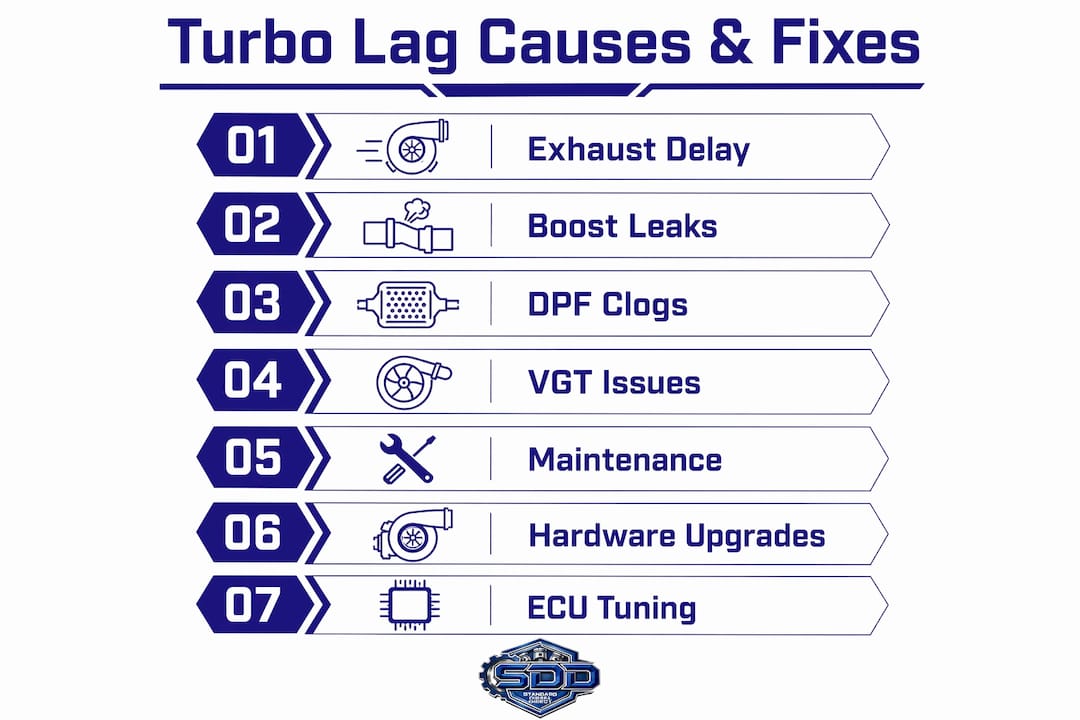
How does turbo lag affect diesel performance and driving?
Turbo lag directly affects throttle response, acceleration, and driver confidence. The most obvious impact is the pause between pressing the accelerator and feeling the truck actually move. On a highway on-ramp or during an overtaking maneuver, that pause creates a real safety concern.
The effects on driving experience include:
-
Delayed acceleration. The truck feels sluggish off the line or when resuming speed after slowing down. This is most pronounced at low RPMs in higher gears.
-
Inconsistent power delivery. The engine feels like it surges once boost arrives, rather than building power smoothly. This makes precise throttle control harder in traffic or when towing.
-
Increased fuel consumption. When the turbo spools slowly, the engine compensates by injecting more fuel to maintain requested power. That extra fuel burns less efficiently during the lag period.
-
Engine stress. Prolonged lag conditions, especially under load, force the engine to work harder before boost arrives. Over time, this adds wear to pistons, rings, and the turbo itself.
Normal turbo lag is inherent and expected; sudden increases in lag often signal secondary system failures such as VGT actuator issues or exhaust obstructions. This distinction matters. If your truck has always had a brief lag at low RPM, that is normal diesel behavior. If the lag has grown noticeably worse over weeks or months, that is a diagnostic signal, not a characteristic to accept.
Pro Tip: Pay attention to whether lag has changed, not just whether it exists. A truck that suddenly lags more than it used to is telling you something specific has failed or degraded.
What maintenance practices reduce turbo lag in diesel vehicles?
Routine maintenance is the most cost-effective way to keep turbo response sharp. Simple fixes like boost hose replacement or DPF cleaning solve lag issues in most cases without touching the turbocharger itself.
Follow this maintenance sequence when diagnosing or preventing excessive lag:
-
Replace the air filter. A fresh air filter restores full airflow to the intake. Diesel trucks working in dusty environments need filter checks every 10,000–15,000 miles, not just at standard service intervals.
-
Inspect all boost hoses and clamps. Run the engine under load and listen for hissing. Use a smoke machine or soapy water on connections to find small leaks that are not audible at idle.
-
Check DPF status and perform regeneration. A clogged DPF is one of the most common causes of worsening lag in high-mileage diesel trucks. Many trucks initiate passive regeneration on the highway, but active regeneration cycles may be needed if the filter is heavily loaded.
-
Service the VGT actuator. The VGT actuator controls turbo vane position. Carbon buildup on the vanes is common in diesels with EGR systems. Cleaning the vanes and testing actuator movement restores proper boost control.
-
Clean or replace fuel injectors. Routine injector cleaning prevents the buildup that degrades spray patterns. Healthy injectors produce better combustion, which produces stronger exhaust pulses to drive the turbo.
-
Maintain engine oil quality. The turbocharger bearings rely on clean engine oil for lubrication and cooling. Degraded oil accelerates bearing wear, which increases shaft play and reduces turbo efficiency.
Pro Tip: Change engine oil at or before the manufacturer’s recommended interval if you tow regularly or operate in extreme temperatures. Turbo bearings are the first component to suffer from oil that has lost its viscosity.
A holistic approach maintaining fuel injectors, air filters, and exhaust systems produces more effective lag reduction than targeting the turbo alone. The turbo is the last link in a chain. Every component before it must be in good condition for the turbo to perform correctly.
What tuning and upgrade options help minimize turbo lag?
Hardware upgrades and ECU tuning can reduce the sensation of turbo lag, but turbo lag can never be fully eliminated due to fundamental physics. Exhaust energy and rotational inertia set hard limits on how fast any turbo can spool. The goal is to work within those limits as effectively as possible.
Modern technology like variable geometry turbos and advanced tuning can reduce turbo lag but not eliminate it. Here is how the main upgrade categories compare:
| Upgrade type | Benefit | Trade-off |
|---|---|---|
| Variable geometry turbo (VGT) | Adjusts vane angle for fast spool at low RPM | Higher cost; requires proper actuator maintenance |
| Aftermarket intake system | Increases airflow volume and reduces restriction | Minimal gain alone; works best combined with other upgrades |
| Performance exhaust upgrade | Reduces backpressure; more exhaust energy reaches the turbo | May affect emissions compliance depending on configuration |
| Professional ECU tuning | Optimizes fueling and boost maps for faster turbo response | Requires a reputable tuner; poor tuning causes engine damage |
| Multi-turbo setup | Smaller primary turbo spools faster at low RPM | Significant complexity and cost; not practical for most street trucks |
| Fuel system upgrade | Consistent fuel delivery supports cleaner combustion and faster spool | Best results when combined with tuning and airflow improvements |
ECU tuning deserves specific attention because it addresses turbo response at the software level. A professional tune adjusts fueling curves, boost targets, and injection timing to get the turbo building pressure faster after throttle input. For diesel owners who want better response without major hardware changes, a quality tune is often the highest-value single upgrade available. Pairing a tune with aftermarket truck upgrades like a performance intake and exhaust produces compounding gains.
Upgrading fuel systems with high-quality components improves combustion efficiency, which directly supports turbo response. Proper fuel delivery complements both factory and aftermarket turbo systems for better driveability across the RPM range.
Key Takeaways
Turbo lag in diesel engines is a physical constant that maintenance and targeted upgrades can reduce, but never fully eliminate.
| Point | Details |
|---|---|
| Turbo lag is normal | A brief delay between throttle input and boost is inherent to all turbocharged diesel engines. |
| Most lag is external | Over 70% of excessive lag cases trace to boost leaks, clogged DPFs, or intake restrictions, not turbo failure. |
| Maintenance comes first | Replacing air filters, fixing boost leaks, and cleaning injectors restores response before any hardware upgrade. |
| VGT and ECU tuning help most | Variable geometry turbos and professional ECU tuning deliver the best reduction in lag sensation for street trucks. |
| Full elimination is impossible | Engine physics set hard limits on spool speed; the realistic goal is minimizing lag, not removing it. |
Fuel system upgrades that support turbo performance
A healthy fuel system is the foundation every turbocharger depends on. When fuel delivery is inconsistent or restricted, combustion quality drops, exhaust energy weakens, and the turbo spools slower regardless of what else has been upgraded.
Standard Diesel Direct carries the FASS Titanium Signature Series Plus fuel systems, engineered to deliver clean, consistent fuel at the correct pressure for light-duty diesel trucks. The Titanium Signature Series Plus for 1998–2004 Dodge Cummins 5.9L is built to support stock through 600HP applications, removing air and contaminants from the fuel supply before they reach the injectors. For Ford Powerstroke owners, the Titanium Signature Series Plus for 2008–2010 6.4L delivers the same clean fuel delivery benefits. Better combustion means stronger exhaust pulses, and stronger exhaust pulses mean a turbo that spools faster and responds more predictably.
FAQ
What is turbo lag in a diesel engine?
Turbo lag is the delay between pressing the accelerator and the turbocharger delivering boost pressure. It occurs because exhaust gases need time to build enough pressure to spin the turbine to boost-producing speeds.
Is turbo lag worse in diesel than gasoline engines?
Yes. Diesel engines operate at lower RPMs and use heavier internal components, both of which increase the time needed for exhaust gases to spool the turbocharger to its boost threshold.
Can turbo lag be completely eliminated?
No. Complete elimination is impossible due to the fundamental physics of exhaust energy and rotational inertia. Tuning and hardware upgrades reduce the sensation significantly but cannot remove it entirely.
What is the most common cause of sudden increased turbo lag?
Boost leaks, clogged DPFs, and faulty VGT actuators are the most common causes of sudden worsening lag. Inspect external systems before assuming the turbocharger itself has failed.
Does a fuel system upgrade help with turbo lag?
Yes. Consistent, clean fuel delivery improves combustion quality, which strengthens exhaust pulses and helps the turbo spool faster. A quality fuel system upgrade supports both factory and aftermarket turbo setups.
Recommended
-
Diesel Lift Pump Performance, Failure, Benefits, Upgrades, and Buying Guide – Standard Diesel Direct
-
Best Truck Upgrades That Are Actually Worth It – Standard Diesel Direct
-
FASS TSC08100G Titanium Signature Series Diesel Fuel System 100GPH GM – Standard Diesel Direct
-
How to Install Diesel Performance Injectors: Full Guide – Standard Diesel Direct