

Replacing a single diesel injector typically runs $600 to $1,800 installed, while a full-bank job on a 6 or 8-cylinder engine lands between $2,800 and $6,500, and sometimes higher on heavier-duty applications. Light-duty trucks getting quality parts and professional labor commonly total several thousand dollars for a complete injector service. The spread comes down to three things: whether you choose OEM, reman, or aftermarket parts, how many labor hours your engine layout demands, and how easy (or brutal) it is to actually reach the injectors.
TL;DR:
- Replacing a full bank of diesel injectors can cost between $2,800 and $6,500, depending on engine access, parts, and labor rates.
- Injector parts range from $350 to over $1,000 each, with labor costs varying from 2 hours for easy access to over 16 hours for complex layouts.
- Ancillary costs such as seals, filters, and core deposits can add up to $400 or more for a full bank repair.
- Diagnostics, cleaning, remanufactured, OEM, or aftermarket injectors each have different costs and suitability based on mileage and contamination levels.
- Proper shop evaluation should include flow-test data, warranty details, and inspection of electrical connectors to prevent repeat failures or hidden damages.
Diesel Injector Replacement Cost Breakdown: Parts, Labor, and Extras
Every quote you get boils down to three line items: injector parts, labor hours, and the small stuff that adds up faster than most owners expect. Understanding each one lets you catch a shop that’s padding a bill versus one that’s charging fairly for a genuinely tough job.
Per-injector parts commonly range from $350 to $1,000 or more depending on whether you’re buying new OEM, premium remanufactured, or budget aftermarket.
Labor is where quotes really diverge. A straightforward single-injector swap on an engine with good access might take 2 to 4 hours, while a full-bank job on a difficult layout can stretch to 8 to 16 hours, and dealer labor rates tend to run higher than independent shop rates for the same work.
Then come the ancillary costs that catch owners off guard. These are small individually, but on an 8-injector job they can add several hundred dollars to the final bill:
- Core deposits, typically $50 to $150 per injector, refundable when you return the old unit
- New crush washers and sealing O-rings for every injector removed
- A fresh fuel filter, often required as part of the service
- Diagnostic fees if the shop needs to flow-test or scan before quoting
Ancillary parts alone commonly add $150 to $400 to a full-bank job. Here’s how a typical single-injector job on a mid-size diesel pickup might break down:
| Cost Component | Typical Range |
|---|---|
| Injector part (reman) | $350 to $1,000 |
| Labor (2–4 hours at $130–$160/hr) | $350 to $1,000 |
| Core charge (refundable) | $50–$150 |
| Sealing washers/O-rings | $50 to $150 |
| Total (installed) | $1,000 to $1,300 |
That math is why two shops quoting the “same job” can land $400 apart. One is running new OEM parts at dealer labor rates; the other is using quality reman with an independent technician who knows the platform.
Why Diesel Injector Quotes Vary So Widely
Engine design drives more of the cost swing than most owners realize. Some diesel platforms put injectors right on top of the engine under an easily removed cover; others bury them under the intake manifold, behind inner fender liners, or under a maze of vacuum lines and wiring harnesses. A Duramax with an easy-access layout might take half the labor time of a Power Stroke variant that requires pulling the upper intake first, or a Cummins configuration where fender work eats an extra hour before you even see the injectors.
Injector technology matters too. Older mechanical injectors are relatively simple to swap. Modern piezo-electric common-rail injectors often require injector coding or calibration after installation, matching each new unit’s flow data to the engine’s computer, which adds shop time and sometimes a scan-tool fee.
One factor to keep in mind: independent diesel specialists sometimes complete the work faster and at lower hourly rates than dealerships, but you should still verify they can handle calibration and that any warranty terms hold up.
Contamination is the wild card that blows up budgets. If a failed injector has been leaking fuel into the oil or dumping soot into the intake, the shop may find.
- Fuel-diluted engine oil requiring an immediate oil and filter change
- Carbon buildup on intake valves needing manual cleaning
- A contaminated fuel system requiring filter and line flushing
Signs of a Bad Diesel Injector and How Shops Diagnose It
Catching a failing injector early is the single best way to keep your repair bill in the hundreds instead of the thousands. Watch for these warning signs:
- Rough idle or a noticeable engine shake at stoplights
- Visible smoke from the tailpipe, black on acceleration or white/gray at idle
- Hard cold starts or extended cranking before the engine catches
- Noticeable power loss or hesitation under load
- Fuel smell in the oil, or oil that looks unusually thin on the dipstick
A shop that’s doing this right won’t just slap on new injectors because you mentioned rough idle. They’ll run:
- A diagnostic code scan to pull stored fault codes and injector trim values
- Cylinder-by-cylinder balance or flow testing to isolate the weak injector
- Compression testing if mechanical wear is suspected alongside injector issues
- Smoke or leak-down analysis when the symptoms point to more than one cause
Left unaddressed, a single bad injector can dilute engine oil and wash cylinder walls, and in worst cases contribute to DPF or turbo damage that escalates repair costs into the $8,000 to $15,000 range. That’s the real cost of ignoring a rough idle for six months. Our guide on what causes diesel injector carbonization breaks down exactly how contamination builds up before symptoms show.
When diagnostics show marginal wear without mechanical damage, cleaning or flow-testing is a smart intermediate step before committing to full replacement.
Cleaning, Reman, OEM, or Aftermarket: Which Fixes the Problem?
Your repair choice should match what the diagnostics actually found, not just what’s cheapest today. Here’s how the four paths stack up:
- Ultrasonic cleaning/flow testing: Costs roughly $75 to $300 per injector and can restore performance when deposits are the only problem, but it cannot fix worn needle valves, scored bores, or electrical faults.
- Remanufactured injectors: Rebuilt to spec with new wear components, usually 30 to 50% cheaper than new OEM, and a solid middle-ground choice for most owners.
- New OEM injectors: Carry the highest upfront cost but come with the longest expected service life and the strongest warranty backing, which matters most on high-mileage trucks you plan to keep.
- Budget aftermarket injectors: Save money immediately but carry real risk of premature failure, meaning you could pay for labor twice.
Pro Tip: If your injectors have under 60,000 miles and no history of fuel contamination, flow testing and cleaning is worth trying first. Past that mileage, or with any contamination in the fuel history, put your money into reman or OEM rather than gambling on a cleaning that might not hold.
Real Shop Labor and Cost Examples by Engine Type
Numbers on a page only mean so much until you see them applied to an actual engine. Labor hours swing dramatically based on access, and that swing is the biggest lever in your final bill.
| Engine Type | Labor Hours | Typical Installed Total |
|---|---|---|
| Compact 4-cylinder diesel (easy access) | 2–4 hrs | $1,000 to $1,300 (single injector) |
| Mid-size 6-cylinder pickup (moderate access) | 4–8 hrs | $2,800 to $6,500 (full bank) |
| Heavy-duty 8-cylinder engine (intake/fender removal) | 8 to 16 hours | $2,800 to $6,500+ (full bank) |
On the compact 4-cylinder example, a single reman injector plus a $50 core deposit and $650 in labor at $150 an hour lands right around $1,000 to $1,300 installed, comfortably inside the ranges reported for diesel common-rail systems.
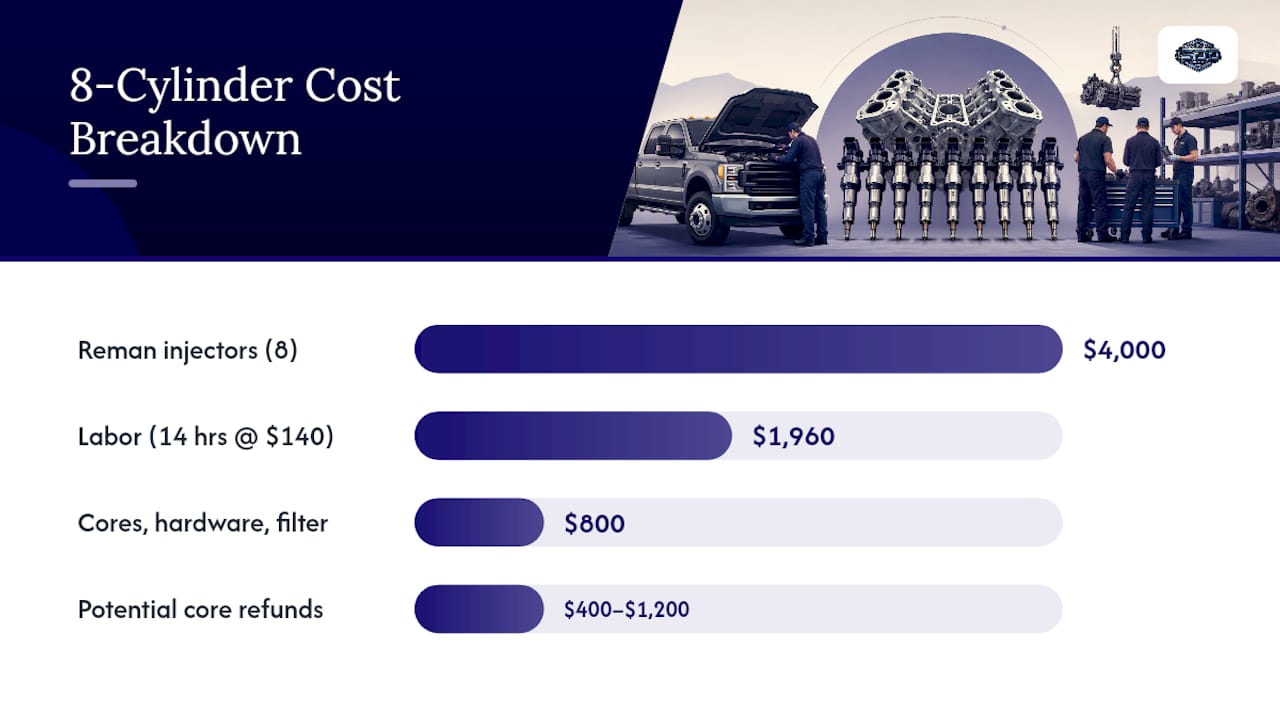
The 8-cylinder example is where full-bank jobs get expensive fast. Eight reman injectors at $500 each is $4,000 in parts alone, before you add 14 hours of labor at $140 an hour ($1,960) and $800 in core deposits, sealing hardware, and a fuel filter. That’s a $6,700+ job, and it’s exactly why core-charge refund terms matter. Get your $50 to $150 per injector back on the old cores, and you just clawed back $400 to $1,200 off that total.
How to Cut Injector Costs Without Cutting Corners
The cheapest injector job is the one you never have to do twice. A few habits protect the investment you already made:
- Change your fuel filter every 10,000 to 15,000 miles to reduce contamination risk
- Run a quality water separator and drain it regularly
- Avoid stacking cheap fuel additives that promise cleaning but lack real diesel certification
- Ask any shop for flow-test printouts, a written core-return policy, and a labor breakdown before you approve work
Pro Tip: A shop that won’t hand you the flow-test numbers on your old injectors isn’t giving you enough information to judge whether replacement was even necessary. Our prevention guide covers filtration upgrades that extend injector life well past factory expectations.
Single Injector or Full Bank: How to Decide
After higher mileage, replacing the full bank is often the smarter financial call, even when only one injector has failed. Injectors that have logged similar mileage and fuel exposure tend to fail in the same window, and paying labor once instead of two or three times saves real money.
- Under 60,000 miles with one isolated failure and clean fuel history: single replacement is reasonable
- Over 100,000 miles, or any history of fuel contamination: full-bank replacement usually pencils out cheaper long-term
- Three single-injector jobs at $1,000 labor each easily exceeds one full-bank job’s labor total
What to Demand From Any Shop Before You Approve the Work
A shop worth paying should hand you real evidence, not just a verbal diagnosis. Standard Diesel Direct’s technical team recommends asking for the flow-test printout on your old injectors, a written breakdown separating parts from labor, the core-return policy in writing, and the specific warranty term on whatever reman or OEM parts they’re installing.
If your injector service includes replacing damaged wiring, don’t overlook the connectors. A corroded or melted injector pigtail can mimic injector failure symptoms and cause a brand-new injector to run poorly. Our performance injector installation guide covers torque specs and electrical checks worth running during any injector job.
- Request the flow-test data, not just a verbal “it’s bad”
- Get the core policy and warranty length in writing
- Ask whether connector pigtails were inspected, not just the injectors themselves
Fix the Connectors While You’re In There
If you’re doing injector work on an L5P Duramax, the wiring harness connectors take just as much heat and vibration abuse as the injectors themselves, and a cracked or corroded pigtail can undo a perfectly good injector swap.
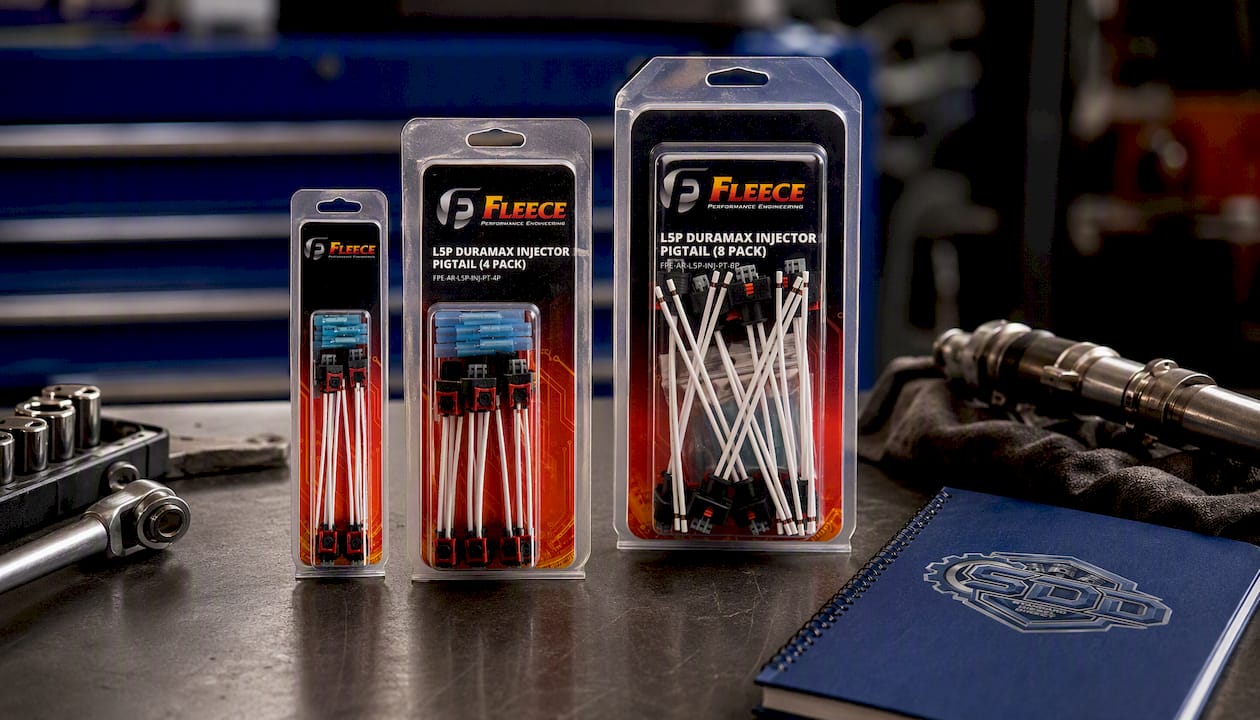
Standard Diesel Direct’s Replacement Fuel Injector Connector With Pigtail for L5P Duramax gives you a direct swap for a single damaged connector, ideal if you spotted one melted or corroded pigtail during diagnosis. Running a partial-bank repair or replacing several suspect connectors at once? The 4-pack covers you without buying more than you need. If you’re pulling the full valve covers for a complete injector service, the 8-pack means every connector on the engine gets replaced in one pass instead of waiting on a second parts order mid-job. Check fitment and grab the pack size that matches your repair scope before you close up the engine bay.
Sources
- Diesel Fuel Injector Failure: Signs, Diagnosis & Repair Procedures
- Diesel Fuel Injector Replacement Costs – Cost Insider
- Fuel Injector Replacement Cost: What You’ll Actually Pay - Daily Car Tips
FAQ
Is It Worth Replacing Diesel Injectors?
Yes, when diagnostics confirm mechanical wear or electrical failure. Replacing a genuinely failed injector protects against oil dilution, cylinder wash, and the kind of turbo or DPF damage that turns a $1,000 repair into an $8,000 one.
Can You Drive a Diesel With a Bad Injector?
You can drive short distances, but a failing injector risks fuel dilution of engine oil, misfiring, and escalating damage to other components the longer it runs. Get it diagnosed before your next long trip.
What Are the Signs of a Faulty Diesel Injector?
Rough idle, tailpipe smoke, hard cold starts, noticeable power loss, and fuel smell in the oil are the most common warning signs. Any combination of these warrants a diagnostic scan and flow test.
How Often Should You Replace Injectors on a Diesel?
There’s no fixed mileage interval; injectors are replaced based on diagnostic results, not a schedule. Many diesel injectors last well past 100,000 miles with clean fuel and regular filter changes, while contaminated fuel or ignored symptoms can cause failure far earlier.