

Diesel injector carbonization is caused primarily by fuel contamination and incomplete combustion. Secondary drivers include thermal damage at the nozzle tip, oil blow-by, EGR soot recirculation, and failed injector seals. Before you spend money on parts, run diagnostics: a DTC scan, an injector balance test, and a return-flow test will tell you exactly what you’re dealing with.
The top contributors to carbon buildup in diesel injectors are:
-
Fuel contamination (water, dirt, trace metals, biodiesel residues)
-
Short trips and low-load driving that prevent the engine from reaching full operating temperature
-
Excessive idling and frequent DPF regeneration cycles
-
Oil blow-by and EGR soot recirculation coating injector tips with combustion byproducts
-
Failed injector seals that allow combustion gases to bake deposits around the bore
Pro Tip: Before ordering replacement injectors, request a return-flow test from your shop. A flow rate above 20 cc/min points to worn internal seals, not just surface deposits, and changes the repair strategy entirely.
Table of Contents
What causes diesel injector carbonization at the chemical level?
There are two distinct deposit types, and they require different fixes. Understanding which one you have is the difference between a $150 cleaning and a $1,500 replacement job.
Nozzle coking refers to carbonaceous deposits that form on the external tip of the injector nozzle. Fuel contacts the hot nozzle surface, partially cracks under heat, and the heavier hydrocarbon fractions polymerize into a hard, carbon-rich layer. According to DieselNet, deposit formation is driven by fuel properties including viscosity, volatility, and the presence of trace metals, with local temperature playing a central role.
Nozzle coking accelerates sharply once nozzle tip temperatures exceed approximately 300°C. At that threshold, the thermal condensation and cracking reactions that produce carbonaceous deposits increase in rate significantly. Modern high-pressure common-rail (HPCR) systems, which operate at pressures exceeding 1,800 bar, routinely push fuel temperatures past 150°C just from pressurization, making nozzle coking a persistent risk in hard-working diesel trucks.
Internal Diesel Injector Deposits (IDID) form inside the injector body rather than on the tip. The most common type in North America is metal carboxylate soap, formed when sodium or calcium contaminants from biodiesel, water ingress, or motor oil react with acidic compounds in the fuel to create sparingly soluble salts. Laboratory SEM/EDS analysis of injector deposits finds carbon, zinc, and oxygen as the most abundant elements, with zinc concentrated near the metal interface and carbonaceous layers building on top. HPCR injectors are especially vulnerable because their internal tolerances are measured in single-digit microns. A deposit just a few microns thick can cause an injector needle or command piston to stick or bind.
Common causes of injector carbon buildup you need to know
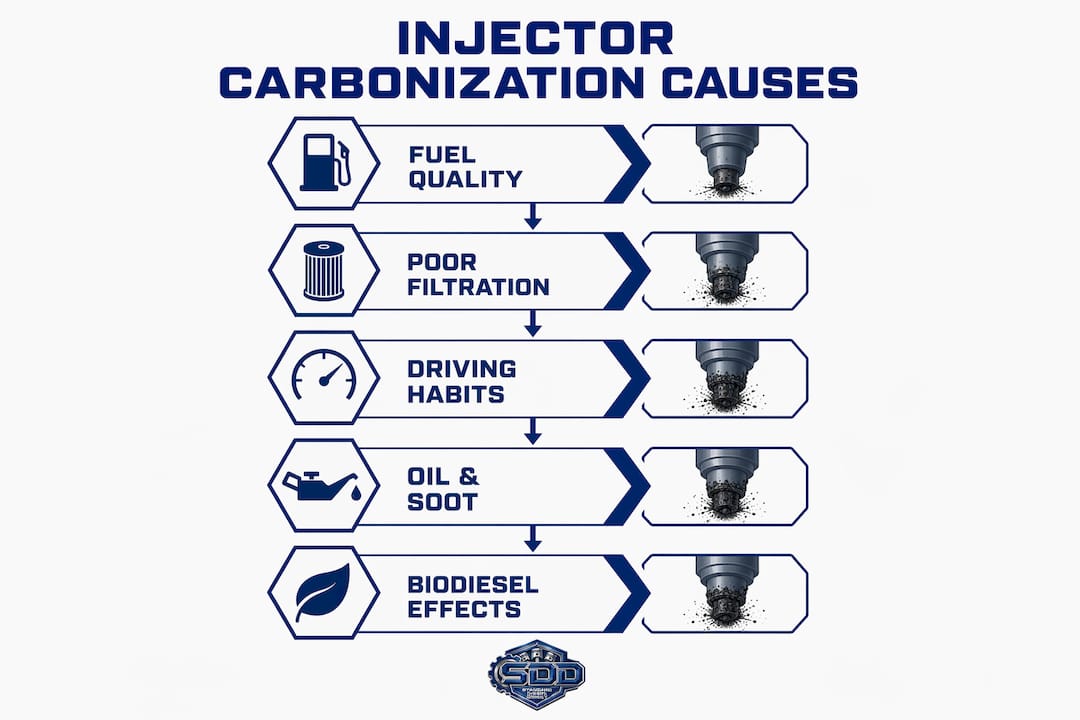
Most injector carbonization problems trace back to one of five root causes. Here’s how each one works and what it means for your truck.

Fuel contamination and poor fuel quality
Fuel quality issues account for approximately 70% of observed common rail injector problems in specialized repair shops. Water is the most damaging single contaminant: it destroys lubricity, causes corrosion on valve seats, and accelerates ball-seat erosion that degrades sealing and spray control. Dirt and microscopic abrasives score precision surfaces, opening gaps that allow fuel bypass and spray pattern degradation. Trace metals, particularly sodium, zinc, and calcium from refinery processes or biodiesel production, catalyze the metal soap chemistry that drives IDID formation.
Poor filtration and non-OE filter specs
Modern HPCR injectors have ball-seat tolerances around 1mm, making them acutely sensitive to sub-micron particles that a low-grade filter passes freely. Bosch’s service guidance lists poor fuel filtration alongside fuel contamination as a leading cause of injector failures. Running a filter with a higher micron rating than OE spec, or extending change intervals past the manufacturer’s recommendation, lets abrasives accumulate and accelerates wear on every precision surface inside the injector.
Short trips, low-load driving, and excessive idling
An engine that never fully warms up never burns fuel cleanly. Short trips leave partially combusted fuel residues on nozzle tips. Excessive idling keeps injection quantities low and combustion temperatures below the threshold needed to burn off light deposits before they harden. Frequent DPF regeneration cycles, which inject raw fuel late in the combustion cycle to raise exhaust temperatures, can push unburned fuel onto nozzle tips if the regen doesn’t complete properly. Understanding how DPF regeneration works helps owners recognize when their driving habits are creating a deposit risk.
Oil blow-by, EGR soot recirculation, and seal failures
EGR systems recirculate exhaust gases back into the intake, and those gases carry soot and oil vapor. Over time, that soot coats injector tips and intake surfaces, contributing to deposit buildup. Oil blow-by from worn piston rings or valve seals adds oil mist to the combustion chamber, where it bakes onto nozzle tips at high temperature.
The most severe seal-failure mode is known as “Black Death.” When an injector’s crush washer or copper sealing washer fails, hot combustion gases escape into the injector bore and bake fuel into a hard, tar-like residue that encases the injector. Cleaning the nozzle alone won’t fix it: the seal must be replaced, the bore cleaned, and in severe cases the seat machined. Catching it early, when you first notice a tar-like residue around the injector base, can prevent full injector seizure and costly cylinder-head repairs.
Biodiesel blends and additive incompatibilities
Fuel additive packages and biodiesel content can either reduce or accelerate deposit formation depending on their composition and stability. Biodiesel oxidation products and degraded additive dispersants interact with trace metals to promote both nozzle coking and IDID. Fuel stored for extended periods, or biodiesel blends held in tanks through temperature swings, degrades faster and introduces more deposit precursors into the injection system.
| Cause | Deposit Type | Primary Risk |
|---|---|---|
| Water contamination | Corrosion, erosion | Ball-seat wear, lubricity loss |
| Trace metals (Na, Ca, Zn) | Metal carboxylate soap (IDID) | Needle/piston sticking |
| Short trips / low load | Nozzle coking | Spray pattern degradation |
| EGR soot / oil blow-by | Carbonaceous nozzle deposits | Power loss, smoke |
| Failed injector seal | “Black Death” tar deposits | Bore damage, seizure |
| Degraded biodiesel blends | Mixed IDID and nozzle deposits | Filter plugging, fouling |
What symptoms tell you injectors may be carbonized?
Carbon buildup in diesel injectors rarely announces itself with a single obvious fault code. The symptoms tend to build gradually, which is why owners often attribute them to other causes for months before the real problem surfaces.
Common driveability symptoms include rough idle, hard starting (especially cold), noticeable loss of power under load, declining fuel economy, and increased black smoke from the exhaust. Localized signs are more specific: a tar-like black residue around the injector base is a strong indicator of “Black Death” seal failure, and a fuel or “tar” smell in the engine bay often accompanies it. Wet-looking, carbon-coated nozzle tips visible during removal confirm nozzle coking.
The challenge with these symptoms is that they overlap significantly with other diesel injector problems. Low rail pressure from a failing high-pressure pump, air in the fuel line, a failing turbocharger, or a faulty rail pressure sensor can all produce rough idle and power loss that looks identical to carbonization. Assuming the injectors are the problem without running targeted diagnostics leads to unnecessary replacements.
That overlap is exactly why a systematic diagnostic sequence matters. The symptoms point you toward the fuel system; the tests tell you which component is actually at fault.
What diagnostic tests should you request from your shop?
A structured diagnostic sequence saves money and prevents replacing parts that don’t need replacing. Here’s the order that makes sense for suspected injector carbonization.
-
DTC scan and live data review. Pull all fault codes and check live rail pressure data. Low rail pressure, injector-specific fault codes, and contribution imbalances all show up here before you touch anything mechanical.
-
Injector balance and cylinder contribution test. This test cuts each injector in sequence and measures the RPM drop. A cylinder that barely drops when its injector is disabled is delivering less fuel than the others, pointing to a restricted or fouled injector.
-
Return-flow test. Connect a graduated cylinder to the injector return line and measure fuel return volume over one minute at idle. A return flow exceeding 20 cc/min confirms worn internal high-pressure seals, which means cleaning alone won’t restore performance.
-
Fuel sample analysis and inline filter inspection. Pull a fuel sample and inspect the inline filter for water, sediment, or discoloration. Water in the filter bowl or a heavily contaminated filter element confirms contamination as the root cause.
-
Off-vehicle bench flow and spray testing. When on-vehicle tests point to specific injectors, send them to a diesel specialist for bench testing. Bench flow testing measures actual delivery volume against spec; spray pattern testing reveals whether the nozzle holes are partially blocked or producing an irregular cone.
Statistic to know: A return fuel flow rate above 20 cc/min is a confirmed indicator of worn internal high-pressure injector seals.
Pro Tip: Ask your shop to photograph the injector tips before and after removal. Nozzle coking is visible as a dark, crusty buildup on the tip. “Black Death” looks like hardened tar around the injector bore. Those photos tell you which remediation path applies before any cleaning starts.
How do you remove carbon from diesel injectors?
Remediation options range from a $30 bottle of fuel-system cleaner to full injector replacement. The right choice depends entirely on what the diagnostics found.
On-vehicle chemical cleaning
Fuel-system cleaners and decarbonizers added to the fuel tank or injected directly into the fuel rail can dissolve light nozzle deposits and improve spray patterns on mildly fouled injectors. They work best as a maintenance measure on injectors with early-stage coking and no internal damage. They will not dissolve hardened IDID, restore a worn ball seat, or fix a failed seal. Expect modest improvements in idle quality and fuel economy when deposits are light; don’t expect a full restoration on injectors with confirmed balance-test failures.
Off-vehicle ultrasonic cleaning and bench verification
Ultrasonic cleaning uses high-frequency sound waves in a solvent bath to dislodge deposits from both the nozzle tip and internal passages. After cleaning, bench flow and spray testing verify that delivery volume and spray pattern meet OE specifications. This combination is the most effective non-replacement option for injectors with moderate nozzle coking and no internal seal damage. Professional injector cleaning procedures typically include both the ultrasonic bath and post-clean flow verification to confirm the result.
Bench verification after ultrasonic cleaning is not optional. An injector that looks clean may still deliver the wrong fuel volume if the nozzle holes are worn or the needle seat is damaged. Flow testing confirms the injector is actually performing to spec, not just visually clean.
When replacement is the right call
Some conditions make cleaning a waste of money:
-
Return-flow test result above 20 cc/min (worn internal seals)
-
Confirmed “Black Death” with bore damage or seat erosion
-
Severe ball-seat wear identified on bench testing
-
Physical corrosion or cracking on the injector body
-
Balance test showing a cylinder contribution below acceptable threshold after cleaning
For light-duty diesel trucks, injector replacement costs vary by engine and brand. Cleaning is typically a fraction of that cost, but only makes sense when the diagnostics support it. Correct reinstallation matters as much as the repair itself: a proper injector installation with new sealing washers and correct torque prevents the combustion-gas leaks that cause “Black Death” to recur.
When should you clean versus replace diesel injectors?
Use the diagnostic results as your decision framework, not the mileage on the odometer.
Clean when: The balance test shows a mild contribution deficit, the return-flow test is below 20 cc/min, bench spray testing shows a degraded but recognizable pattern, and there is no physical damage or “Black Death” residue present. Ultrasonic cleaning with bench verification is the appropriate path.
Replace when: Return flow exceeds 20 cc/min, “Black Death” is confirmed with bore damage, bench flow testing shows delivery volume outside OE spec after cleaning, or the injector body shows corrosion or cracking. Cleaning a mechanically failed injector delays the inevitable and risks cylinder-head damage.
A practical checklist for your shop conversation:
-
Request the return-flow test result in cc/min (threshold: 20 cc/min)
-
Ask for before/after spray pattern photos from bench testing
-
Confirm whether “Black Death” residue is present at the bore
-
Ask for the balance test contribution percentage for each cylinder
-
Verify that new sealing washers are included in any reinstall
How to prevent injector carbonization in your diesel truck
Prevention is cheaper than any remediation option. These practices address the root causes directly.
-
Buy fuel from high-volume, reputable stations. High-turnover stations have fresher fuel with less oxidative degradation. Avoid fuel that has sat in storage tanks for extended periods, especially biodiesel blends in cold climates.
-
Use OE-spec filters and change them on schedule. Non-OE filters with higher micron ratings pass particles that HPCR injectors cannot tolerate. A quality lift pump and filtration upgrade adds a reliable water separator and pre-filter stage that protects the entire injection system.
-
Install a water separator if you don’t already have one. Water is the single most damaging contaminant for common rail systems. A dedicated water separator upstream of the injection pump removes free water before it reaches precision surfaces.
-
Avoid frequent short trips and extended idling. When possible, allow the engine to reach full operating temperature on each drive. Limit stationary idling to what the application requires.
-
Monitor DPF regeneration behavior. Incomplete regen cycles deposit raw fuel on nozzle tips. If your truck is triggering frequent forced regens, address the underlying cause rather than letting the cycle repeat.
-
Schedule periodic fuel-system inspections. Pull the inline filter for inspection every service interval. Discoloration, water in the bowl, or heavy sediment signals a contamination problem that needs to be traced to its source.
Pro Tip: If diagnostics point to contamination as the root cause of your injector problems, fixing the injectors without upgrading the filtration system means you’ll be back in the same situation within a year. Address the source, not just the symptom.
Key Takeaways
Diesel injector carbonization is primarily driven by fuel contamination and incomplete combustion, and the return-flow test (threshold: 20 cc/min) is the single most important diagnostic before any repair decision.
| Point | Details |
|---|---|
| Root causes to address first | Fuel contamination accounts for approximately 70% of injector deposit problems observed in specialized repair shops. |
| Diagnostic priority | Run DTC scan, then balance test, then return-flow test; a result above 20 cc/min indicates worn internal seals. |
| Two deposit types | Nozzle coking (external) and IDID (internal) require different fixes; bench testing distinguishes them. |
| Prevention essentials | OE-spec filtration, quality fuel, water separation, and avoiding frequent short trips reduce deposit recurrence. |
| Standard Diesel Direct | Offers FASS fuel systems and filtration upgrades that address the contamination root cause before it reaches your injectors. |
Protect your injectors before the damage starts

When diagnostics point to contamination as the cause of your injector problems, the most cost-effective move is upgrading the filtration and fuel delivery system that feeds them. Standard Diesel Direct carries FASS Titanium Signature Series fuel systems that combine a high-output lift pump, a multi-stage filtration assembly, and a water separator in one unit, delivering clean, properly pressurized fuel to your injectors on every cycle. For Duramax owners, the FASS TSC13250F220G Titanium Signature Series is a direct-fit upgrade that removes the contamination risk the factory system leaves unaddressed. If you’re running a 2020–2022 Duramax, the Titanium Signature Series 220GPH system is built specifically for your application. Browse the full fuel system and filtration catalog at Standard Diesel Direct and find the right fit for your truck before the next service interval.
Useful sources and further reading
The following technical references and guides were used to support the diagnostic and prevention guidance in this article.
-
Injector deposits — DieselNet: Primary technical reference for nozzle coking mechanisms, IDID chemistry, and temperature thresholds.
-
Internal Diesel Injector Deposits — CRC Report 665: Industry consensus report on IDID chemistry, metal soap formation, and HPCR system sensitivity.
-
Characterization of deposits on diesel injectors — Imperial College: Laboratory SEM/EDS analysis of deposit composition by duty cycle and fuel formulation.
-
Fuel quality and diesel injector deposits — SAE 2012-01-1693: SAE paper on additive and biodiesel effects on deposit formation and filter plugging.
-
Common rail injector problems — VFIDiesel: Repair-shop data on contamination as the dominant cause of common rail failures.
-
Common rails, common problems — Diesel World: Practical diagnostics guide including return-flow test thresholds and water contamination effects.
-
Common rail injector failures — Bosch service bulletin: OEM guidance on filtration spec, installation, and contamination-related failure modes.
-
Diesel injector “Black Death” — Intake Cleaning: Detailed explanation of seal-failure mechanics and bore-cleaning requirements.
-
Risks of neglecting engine decarbonization — Digi Paris Sud: Complementary reference on the cost and risk profile of deferred injector maintenance.
-
Diesel lift pump guide — Standard Diesel Direct: Covers lift pump roles, failure symptoms, and filtration upgrade options for diesel trucks.
-
How to install diesel performance injectors — Standard Diesel Direct: Step-by-step installation guide covering torque specs, sealing washers, and common installation errors.
Recommended
-
How to Install Diesel Performance Injectors: Full Guide – Standard Diesel Direct
-
Diesel Particulate Filter Explained for Truck Owners – Standard Diesel Direct
-
Diesel Intercooler Upgrade Guide for Truck Owners – Standard Diesel Direct
-
What Is Diesel Turbo Lag? Causes, Fixes, and Tuning – Standard Diesel Direct