

What is HPFP failure in diesel engines?
HPFP failure in a diesel engine means the high-pressure fuel pump can no longer build or maintain the fuel rail pressure required for proper injection and combustion. In a common rail diesel system, the HPFP takes low-pressure fuel from the tank and compresses it to extreme levels, often exceeding 20,000 PSI in heavy-duty applications, so injectors can atomize fuel precisely. When that pressure drops, the entire injection system suffers, regardless of injector condition.
The effects show up fast:
- Fuel rail pressure falls below the ECM’s commanded target
- Injectors receive insufficient pressure for proper fuel atomization
- Combustion becomes inconsistent across cylinders
- Engine performance degrades from mild hesitation to complete no-start
Identifying common symptoms of HPFP failure in diesel vehicles
HPFP failures rarely happen without warning. The symptoms build gradually, giving you a window to act before the pump quits entirely.
- Extended cranking: A healthy pump builds rail pressure within 2–3 seconds; a worn pump may need 8–10 seconds before the engine fires, especially on cold mornings.
- Power loss under load: The engine feels strong at light throttle but bogs or hesitates during passing, towing, or hill climbing.
- Rough idle: Inconsistent fuel delivery creates uneven combustion, producing noticeable vibration through the cab.
- Engine misfires: Insufficient rail pressure causes injectors to misfire, particularly at higher RPM or under heavy load.
- Check engine light: The ECM logs codes when fuel pressure deviates from target values.
- Stalling: The engine may die unexpectedly at speed, removing power steering and brake assist simultaneously.
- Poor fuel economy: Disrupted combustion efficiency forces the engine to burn more fuel for the same output.
One symptom that often gets dismissed is a metallic ticking noise near the pump housing that increases with RPM. On cam-driven pumps, this sound frequently points to cam follower wear or internal plunger damage, not a valve train issue.
Pro Tip: Symptom overlap is the biggest diagnostic trap with HPFP problems. Hard starting, misfires, and power loss also appear with clogged fuel filters, a weak lift pump, and failing injectors. Never condemn the HPFP based on symptoms alone; always confirm with live pressure data.
What causes high-pressure fuel pump failure in diesel engines?
Most HPFP failures trace back to two preventable factors: fuel contamination and inadequate lubricity. The pump relies on diesel fuel itself to lubricate its internal moving parts, so fuel quality directly determines pump longevity.
- Fuel contamination: Water and particulate matter act as grinding agents on precision pump surfaces, accelerating wear at the microscopic tolerances where the pump operates. Water also promotes internal corrosion and eliminates the fuel film that protects plungers.
- Low fuel lubricity: Ultra-low sulfur diesel, the standard fuel sold across the United States, has reduced lubricity compared to older diesel formulations. That reduction increases friction on internal components and speeds up metal wear.
- Mechanical wear: Reciprocating plungers under extreme pressure develop scoring and grooves over time, creating internal leakage paths that reduce pressure output.
- Cam follower failure: On cam-driven pumps, a worn follower causes metal-on-metal contact that rapidly destroys both the follower and the camshaft lobe, sending debris into the fuel system.
- Solenoid and electronic failures: The inlet metering valve controls fuel flow into the pump chamber. A stuck or electrically failed solenoid starves the pump or prevents proper pressure regulation, setting codes like P2293 or P2294.
When a pump fails through internal wear, it sheds metallic debris into the fuel system. Those particles travel through the common rail, through the injectors, and back toward the tank, contaminating every component along the way. Installing a new pump into a contaminated system destroys the replacement quickly.
Diagnostic insights and error codes associated with HPFP failure
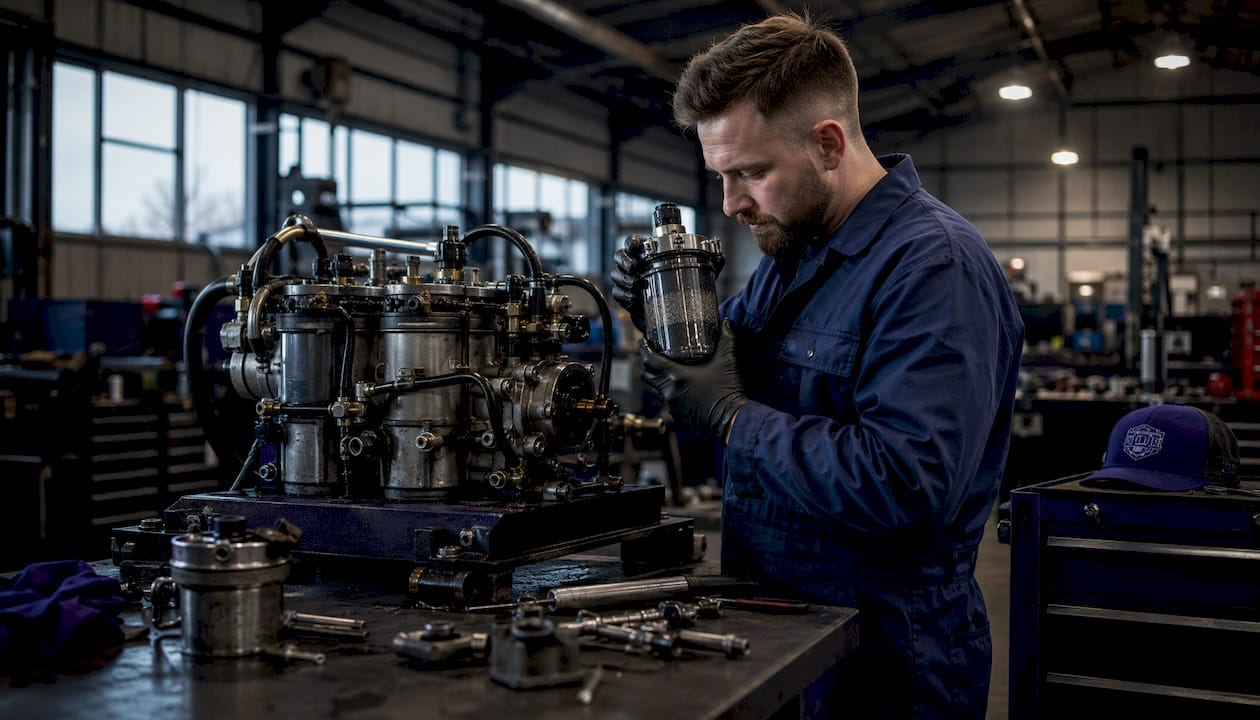
Accurate diagnosis requires more than reading a code. The P0087 trouble code (Fuel Rail Pressure Too Low) is the most common HPFP-related DTC, but it does not confirm pump failure on its own. A clogged fuel filter or a weak lift pump produces identical symptoms and the same code.
Key diagnostic trouble codes to know:
- P0087: Fuel rail pressure below commanded value; pump failure, supply restriction, or excessive return flow
- P0191: Fuel rail pressure sensor circuit performing erratically
- P2293 / P2294: Fuel pressure regulator performance faults, often tied to the inlet metering valve
- P0093: Large fuel leak detected in the system
The most reliable diagnostic approach combines a mechanical pressure gauge with live scan tool data. If the mechanical gauge shows correct pressure but the scan tool displays low pressure, the sensor is faulty, not the pump. If both show low pressure while the ECM commands high duty cycle, the pump is mechanically failing.
Always verify the low-pressure supply side first. Connect a gauge to the inlet side of the HPFP and confirm the lift pump delivers adequate pressure at idle and under load. A weak lift pump starves the HPFP, producing every symptom of pump failure while the HPFP itself remains mechanically sound. Skipping this step is the single most common and expensive diagnostic mistake.
What happens if you ignore HPFP failure?
Continuing to drive with a failing HPFP accelerates damage at every level of the fuel system. The most immediate risk is metallic debris. As internal pump components wear, metal particles circulate through the common rail and injectors, scoring surfaces that would otherwise last hundreds of thousands of miles. By the time the pump quits completely, the injectors often need replacement too.
A lean condition from chronically low rail pressure creates a secondary risk: pre-ignition and detonation. That combustion stress loads pistons and head gaskets beyond their design limits. On engines with cam-driven pumps, an ignored cam follower failure grinds down the camshaft lobe with every revolution, turning a $100 follower replacement into a $1,000-plus camshaft job. The repair scope expands fast when warning signs go unaddressed.
How to prevent HPFP failure through maintenance
Fuel quality and filter maintenance prevent the vast majority of HPFP failures. These are not complicated habits, but they require consistency.
- Use quality diesel fuel from high-volume stations with good fuel turnover. Avoid fuel that has sat in storage tanks for extended periods.
- Change the fuel filter on schedule. A clogged filter restricts flow to the HPFP, forces the pump to work harder, and allows contaminants to pass through. Most manufacturers recommend replacing fuel filters on a regular schedule suited to operating conditions.
- Drain the water separator regularly. Water in diesel fuel is one of the fastest ways to destroy pump internals.
- Inspect cam followers on susceptible engines. On platforms with known follower wear issues, pull the HPFP and check the follower every 20,000 miles. The part costs under $100; the camshaft replacement it prevents can exceed $1,000.
- Monitor live fuel pressure data. A quality scan tool that shows commanded versus actual rail pressure catches early pump degradation before it becomes a breakdown.
Repair and replacement costs for a failing HPFP
HPFP replacement is one of the more expensive single-component repairs on a modern diesel. The pump itself can be expensive, with costs varying significantly between light-duty gasoline and commercial diesel systems. Labor adds to that figure, typically several hours of shop time depending on engine access.
The real cost driver is system contamination. If the pump shed metallic debris before replacement, the repair scope expands to include injector inspection or replacement, fuel rail cleaning, fuel line flushing, and tank cleaning. Skipping those steps and bolting in a new pump guarantees premature failure of the replacement. On platforms like the CP4-equipped Ford Powerstroke and GM Duramax, catastrophic pump failure routinely requires full fuel system replacement, pushing total repair costs well beyond the pump price alone.
Remanufactured pumps offer a lower-cost alternative to OEM units, but quality varies. Confirm the remanufacturer pressure-tests each unit and backs it with a warranty before purchasing.
How HPFP failure differs across diesel engine models
Not every diesel engine fails the same way. The specific failure mode, its severity, and the downstream damage depend heavily on pump design and platform.
CP4-equipped engines (2011+ Ford Powerstroke 6.7L and GM Duramax): The CP4 pump is particularly sensitive to low-lubricity fuel. When it fails, it typically fails catastrophically, releasing metal debris throughout the entire fuel system. Flushing alone does not remove all particles; full system replacement is often required.
VW/Audi 2.0T TSI engines: The cam follower is the primary failure point on early EA888 engines. The follower wears rapidly, destroying the camshaft lobe and the pump plunger. Symptoms include a sharp metallic tick near the pump that increases with RPM, followed by low fuel rail pressure codes.
Cummins and Duramax heavy-duty platforms: These engines operate at higher rail pressures and are more sensitive to supply-side starvation. Lift pump failure or a severely clogged filter produces HPFP symptoms quickly. A quality lift pump upgrade that maintains consistent inlet pressure protects the HPFP from starvation damage across a wide range of operating conditions.
Diesel manufacturers often publish technical service bulletins addressing platform-specific HPFP failure patterns. Checking for active TSBs on your engine before starting diagnosis can save significant diagnostic time.
Protect your fuel system before the HPFP fails

A failing HPFP rarely gives you a second chance once debris enters the fuel system. Standard Diesel Direct carries FASS Titanium Signature Series fuel systems designed to deliver clean, consistent fuel pressure to your HPFP, eliminating the supply-side starvation and contamination that cause most pump failures. Whether you run a Dodge Cummins, Ford Powerstroke, or GM Duramax, there is a system built for your truck.
Upgrade your fuel delivery with the Titanium Signature Series and stop HPFP failure before it starts.
Key Takeaways
Fuel contamination and supply-side starvation cause the majority of HPFP failures, and catching the problem early through live pressure data prevents the system-wide damage that makes this repair so expensive.
| Point | Details |
|---|---|
| HPFP role | The pump pressurizes fuel to extreme levels for injector atomization; failure disrupts the entire injection system. |
| Early warning signs | Extended cranking taking noticeably longer than usual and power loss under load are the first reliable indicators. |
| Root causes | Fuel contamination, low-lubricity diesel, mechanical wear, and cam follower failure account for most failures. |
| Diagnosis requires dual verification | Compare mechanical gauge readings with live scan tool data; always confirm lift pump health before condemning the HPFP. |
| Ignoring failure escalates costs | Metal debris from a worn pump contaminates injectors, rails, and lines, turning a pump replacement into a full system repair. |
Recommended
- Bosch CP4 Fuel Pump Failure: Symptoms, Causes, Repair Costs, Preventio – Standard Diesel Direct
- Diesel Lift Pump Performance, Failure, Benefits, Upgrades, and Buying Guide – Standard Diesel Direct
- What Is Diesel Turbo Lag? Causes, Fixes, and Tuning – Standard Diesel Direct
- Diesel Particulate Filter Explained for Truck Owners – Standard Diesel Direct