

If your diesel truck is showing unexplained coolant loss and white steam from the tailpipe, a failing EGR cooler is a strong suspect. The three highest-probability signs are white or gray steam from the exhaust (especially at cold start), a dropping coolant level with no puddle under the truck, and an overheating or pressurizing cooling system. Internal cracking in the EGR cooler can push coolant into the intake or exhaust, and in severe cases cause hydrolock that bends connecting rods.
Top EGR cooler failure symptoms to check first:
- White or gray steam from the tailpipe, often with a sweet smell
- Coolant level dropping with no visible external leak
- Bubbling or pressurization in the coolant overflow or degas bottle
- Check engine light with DTCs such as P0401 (insufficient EGR flow)
- Rough idle, misfire, or loss of power under load
- Coolant residue or brown/pink sludge in charge-air boots or intake pipes
Pro Tip: If you suspect hydrolock (the engine cranks hard or won’t turn over), do not attempt to restart it. Pull the glow plugs or injectors and check for coolant in the cylinders before turning the engine over.
Key Takeaways
A failing EGR cooler on a diesel truck produces three unmistakable early signs: white or gray exhaust steam, unexplained coolant loss with no external puddle, and a pressurizing or bubbling overflow tank.
| Point | Details |
|---|---|
| Top three warning signs | White exhaust steam, coolant loss with no puddle, and a pressurizing overflow tank are the highest-priority signals. |
| Diagnostic order | Start with a scan tool and visual intake check, then run a cooling-system pressure test before removing any parts. |
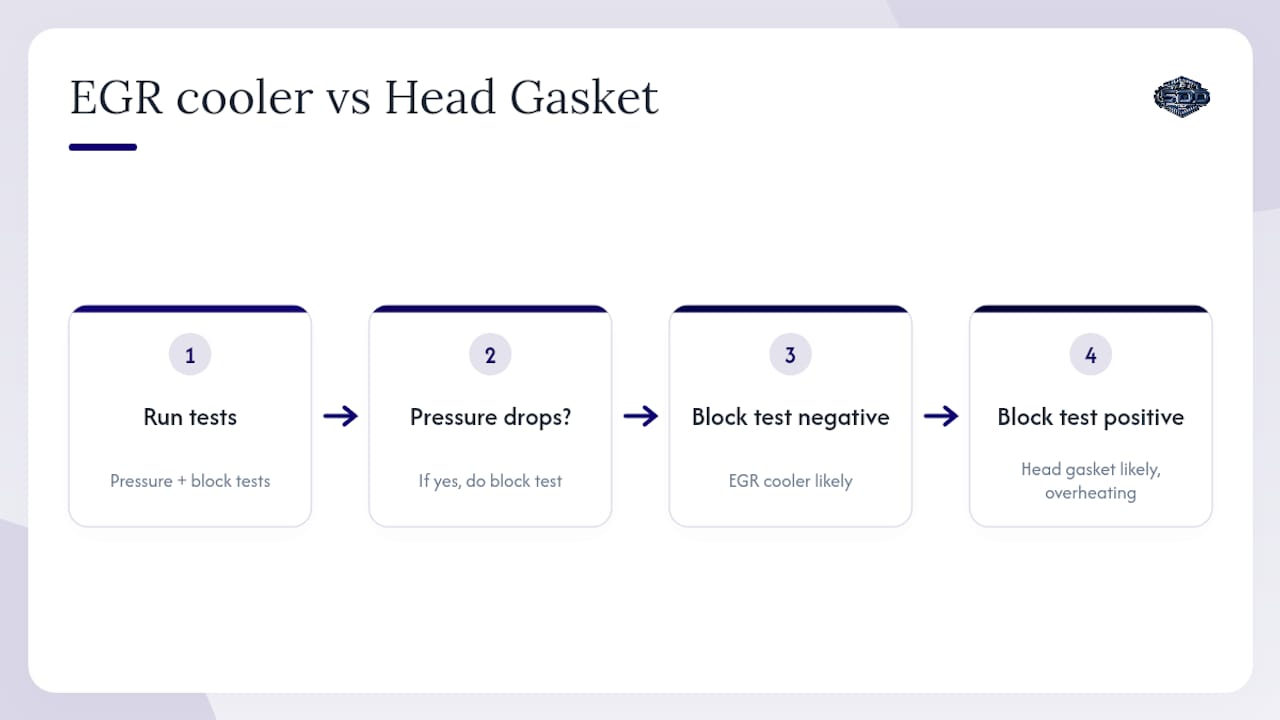
| EGR vs. head gasket | A negative block test with internal pressure loss points to the EGR cooler; a positive block test raises head gasket concern. |
| Repair cost range | EGR cooler replacement typically runs a few hundred to just over a thousand dollars for parts and labor; confirmed head damage can add several thousand dollars more. |
| Standard Diesel Direct | Carries fitment-specific diesel truck parts; confirm vehicle year, make, model, and engine code before ordering. |
What does the EGR cooler do, and why does failure matter?
The EGR (Exhaust Gas Recirculation) cooler routes a portion of exhaust gas through a coolant-filled heat exchanger before it re-enters the intake. This lowers combustion temperatures, reduces NOx emissions, and keeps intake charge temps manageable on diesel engines. On heavy-duty platforms like the 6.6L Duramax, 6.7L Cummins, and 6.7L Power Stroke, the EGR cooler works under significant thermal stress every time the engine cycles.
When the internal core cracks or corrodes, coolant crosses into the exhaust or intake path. That contamination drives the symptoms in the BLUF above. Left unchecked, the consequences escalate quickly:
- Coolant entering the intake contaminates the turbo inlet and charge-air plumbing
- Coolant in the combustion chamber creates hydrolock risk
- Coolant mixing with engine oil produces a milky, frothy contamination that destroys bearing surfaces
- Continued operation risks head gasket failure, cylinder head damage, and emissions system faults
The difference between a $600 EGR cooler job and a $4,000+ head repair often comes down to how fast the problem is caught.
EGR cooler failure symptoms: a detailed checklist for diesel trucks
Work through these in order. Each one tells you something specific about where the failure stands.
-
White or gray steam from the exhaust. Coolant burning in the combustion chamber or exhaust path produces white steam, often with a faintly sweet smell. It’s most pronounced at cold start and may clear as the engine warms, which is a key timing clue. White tailpipe smoke and missing coolant in the degas bottle are among the most reliable early indicators on heavy-duty trucks.
-
Coolant level dropping with no external puddle. Check the degas bottle or overflow tank daily for a few days. A consistent drop with no wet spots under the truck points to an internal leak path, not a hose or fitting failure.
-
Overheating or pressurized cooling system. A cracked EGR cooler can allow combustion pressure to enter the coolant circuit, causing the overflow tank to bubble or pressurize. If the cap blows or the tank is hard to the touch when cold, that’s a red flag.
-
Rough idle, misfire, or power loss. Coolant in the intake disrupts combustion. On a diesel, this often shows up as a rough idle, increased black smoke when warm, or a noticeable power drop under load.
-
Coolant residue in charge-air boots or intake pipes. Pull the intake boot between the intercooler and the throttle body. Brown or pink sludge, or a slick oily residue with a coolant smell, is a near-certain sign that coolant has migrated through the EGR system. Slimy or coolant-contaminated charge-air plumbing is a common early indicator on diesel trucks.
-
External coolant leaks around the EGR cooler or exhaust manifold. Some failures crack the external housing rather than the internal core. Look for dried coolant staining, white mineral deposits, or wet spots around the EGR cooler body and its coolant fittings.
-
Check engine light with EGR-related DTCs. P0401 (insufficient EGR flow) is the most common code, but low-coolant warnings and misfire codes can accompany it. A scan tool with live data will show EGR valve position, coolant temp, and MAF readings that help confirm the picture.
Pro Tip: Cold-start white steam that disappears within two minutes is often normal condensation. If it persists past warm-up or carries a sweet smell, treat it as a symptom, not a quirk.
How to diagnose an EGR cooler leak step by step
This sequence moves from quick visual checks to definitive tests. Stop and call a shop if you reach a step that requires specialized equipment you don’t have.
-
Pull codes and live data. Connect a scan tool and record all active and pending DTCs. Note coolant temperature, EGR valve position, and MAF readings at idle. Abnormal EGR flow or coolant temp spikes narrow the suspect list fast.
-
Visual inspection of the intake and charge-air plumbing. Remove the intake boot between the intercooler and throttle body. Look for brown or pink sludge, oily residue, or a coolant smell. This is often the fastest confirmation available.
-
Check the coolant level and overflow behavior. With the engine cold, note the level in the degas bottle. Start the engine and watch for bubbling or rapid pressurization. Bubbling at idle points to combustion gases entering the coolant circuit.
-
Cooling-system pressure test. With the engine cold, attach a cooling-system pressure tester to the radiator or degas bottle cap. Pressurize to the system’s rated cap pressure (typically 13–16 PSI for most diesel trucks). A pressure drop with no external leak visible points to an internal path such as the EGR cooler.
-
Isolated EGR cooler pressure test. Remove the EGR cooler and cap or plug its ports. Pressurize the cooler to 15–20 PSI using a soapy-water bubble check when manufacturer specs aren’t available; rapid pressure loss with visible bubbles confirms an internal leak. Some OEM bench protocols go higher. One OEM diagnostic document specifies pressurizing to 55 PSI for 10 minutes, treating a pressure drop greater than 5 PSI as a failure condition.
-
Combustion-gas-in-coolant (block) test. A chemical block test uses a color-change fluid to detect combustion gases dissolved in the coolant. A positive result confirms combustion pressure is entering the coolant circuit, which can indicate either a head gasket or an EGR cooler failure.
-
Smoke test (if available). A shop-grade smoke machine introduced into the intake can reveal where coolant vapor is entering the system, useful when the source is ambiguous.
Recommended tools: OBD2 scan tool with live data, cooling-system pressure tester, soapy-water spray bottle, combustion block test kit, basic hand tools, and safety gloves and eye protection.
Safety warning: Never pressure-test a hot cooling system. If hydrolock is suspected, do not crank the engine. Have a qualified diesel mechanic perform tests if you’re unsure of any step.
How do you tell an EGR cooler leak from a blown head gasket?
These two failures share several symptoms, and misdiagnosing them leads to expensive, unnecessary teardown. Here’s how to separate them before pulling the head.
More likely EGR cooler:
- White steam at idle or cold start that clears when warm
- Coolant residue or sludge specifically in charge-air boots and intake pipes
- Pressure loss on a cooling-system test with no external leak, but a negative block test
- No significant overheating; coolant loss is gradual
More likely head gasket:
- Persistent overheating that doesn’t resolve
- Rapid pressure spikes in the cooling system at idle (combustion pressure entering coolant fast)
- Coolant in the engine oil (milky dipstick reading)
- Positive combustion block test result
A cooling-system pressure test followed by a combustion-gas-in-coolant block test is the standard sequence for separating these two failure modes; pressure loss without an external leak points to internal paths like the EGR cooler.
Pro Tip: If the pressure test shows internal loss but the block test is negative, move the EGR cooler to the top of your suspect list and do the isolated cooler pressure test before touching the head. This sequence alone saves many owners an unnecessary head gasket job. See the Standard Diesel Direct diesel head gasket guide for a deeper comparison.
Why do EGR coolers fail, and what happens if you keep driving?
Common causes of EGR cooler failure on diesel trucks include:
- Internal corrosion from coolant degradation or extended service intervals
- Thermal cycling stress from repeated hot/cold cycles cracking the internal core
- Soot buildup restricting flow and concentrating heat in specific sections
- Coolant contamination from a previous failure introducing debris into the system
- Manufacturing weak spots on certain engine families, particularly high-mileage platforms where the EGR cooler sees heavy use
The failure progression is predictable. A small internal crack causes creeping coolant loss and occasional white steam. As the crack widens, coolant enters the intake more consistently, sludge builds up in the charge-air plumbing, and the cooling system begins to pressurize. At the severe end, enough coolant reaches the combustion chamber to cause hydrolock, which can bend connecting rods and require a full engine rebuild.
Short-term tolerable: gradual coolant loss with no overheating, occasional white steam at cold start, P0401 code with no drivability complaint. These allow a prompt shop visit but not indefinite driving.
Immediate stop-driving conditions: persistent overheating, hard or no-crank (hydrolock suspected), milky engine oil, or coolant actively bubbling in the overflow tank at idle.
Repair options and what EGR cooler replacement costs in the U.S.
Replacement is the standard recommendation for a confirmed internal EGR cooler failure. Internal core damage is difficult to repair reliably, and a patched cooler rarely holds long under diesel operating pressures.
Typical repair paths:
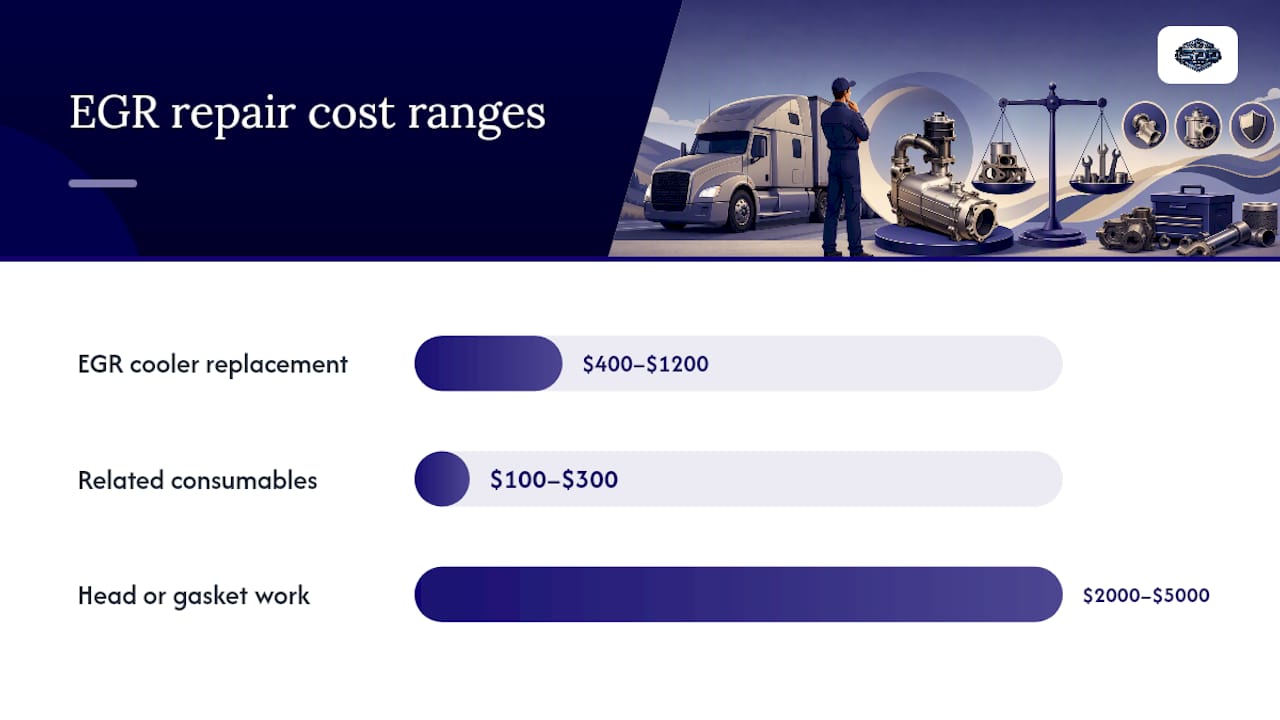
- EGR cooler replacement only: parts plus labor typically runs $400–$1,200 for most light-duty diesel trucks, depending on the engine family and shop labor rate. Labor alone ranges from 2–5 hours on accessible installations.
- EGR cooler plus related gaskets, hoses, and coolant flush: add $100–$300 for consumables. Always replace the coolant when the system has been opened.
- Head gasket or cylinder head work (if damage is confirmed): costs climb to $2,000–$5,000 or more depending on the extent of damage and whether the head needs resurfacing or replacement.
When you take the truck to a shop, ask for pressure-test documentation before and after the repair, request a coolant and oil inspection to confirm no contamination remains, and have the technician inspect the charge-air plumbing and turbo inlet for sludge. Contaminated intercooler boots are worth replacing at the same time. For related charge-air system context, the Standard Diesel Direct intercooler upgrade guide covers what to look for in that plumbing.
Pro Tip: Always confirm part fitment by vehicle year, make, model, and engine code before ordering. EGR cooler designs vary significantly between model years even on the same platform.
Standard Diesel Direct’s shop-style diagnostic checklist
Use this checklist in order to build a defensible, documented diagnosis before any parts come off the truck.
- Connect a scan tool; record all DTCs and live data (coolant temp, EGR valve position, MAF).
- Inspect charge-air boots and intake pipe for brown/pink sludge or coolant residue.
- Check the degas bottle or overflow tank level; note any bubbling at idle.
- Perform a cold cooling-system pressure test; record gauge readings and hold time.
- Check the dipstick for milky or frothy oil (coolant-in-oil contamination).
- Remove and isolate the EGR cooler; perform a soapy-water bubble test at 15–20 PSI, or follow the OEM bench protocol if available.
- Run a combustion block test on the coolant sample.
- Photograph all findings: intake residue, gauge readings, coolant color, and dipstick condition.
- Replace the EGR cooler, related gaskets, and hoses; flush the cooling system.
- Retest cooling-system pressure after reassembly to confirm the repair.
Pro Tip: Document every step with photos and gauge readings. Shops commonly charge 0.5–7 hours of diagnostic and replacement labor depending on the engine family, and documented pre-repair evidence protects warranty claims and prevents disputes about what was found.
Fittings at the EGR cooler coolant inlet and outlet are common sources of false positives on pressure tests. Inspect and torque those fittings before condemning the cooler itself.
Where to find fitment-specific diesel parts
When an EGR cooler diagnosis points to replacement, getting the right part for your specific truck matters as much as the repair itself. Standard Diesel Direct carries fitment-specific aftermarket parts for diesel pickup trucks, with vehicle-specific guidance to help you confirm compatibility before you order. The item customizations page is a good starting point for owners who need to specify their exact build.
If the EGR cooler failure has contaminated the exhaust side and you’re considering a system refresh, the Banks Power Monster Exhaust for 11–15 Chevy/GMC 2500/3500 and 2016 2500 6.6L Duramax LML (DRW) and the SRW version are available for Duramax owners looking to upgrade while the system is already apart. For complex jobs, professional installation is recommended. Verify your vehicle’s year, make, model, and engine code against the fitment specs before purchasing any part.
Sources
FAQ
What happens when an EGR cooler goes bad?
A failing EGR cooler leaks coolant into the intake or exhaust, causing white steam, unexplained coolant loss, rough idle, and eventual overheating. Left unaddressed, it can lead to hydrolock, contaminated engine oil, and cylinder head damage.
How do you tell if it’s a head gasket or EGR cooler?
Run a cooling-system pressure test followed by a combustion block test. If pressure drops internally but the block test is negative, the EGR cooler is the more likely culprit. A positive block test with persistent overheating points more strongly to the head gasket.
How do you test if an EGR cooler is bad?
Remove and isolate the EGR cooler, cap its ports, and pressurize it to 15–20 PSI with a soapy-water bubble check. Rapid pressure loss with visible bubbles confirms an internal leak. OEM bench protocols may specify higher pressures, such as 55 PSI for 10 minutes with a greater-than-5 PSI drop as the failure threshold.
Is an EGR cooler expensive to replace?
On most light-duty diesel trucks in the U.S., EGR cooler replacement runs roughly $400–$1,200 for parts and labor combined. Costs rise if the failure has caused head gasket or cylinder head damage, where repairs can reach $2,000–$5,000 or more depending on the extent of the damage.
Recommended
- Diesel Intercooler Upgrade Guide for Truck Owners – Standard Diesel Direct
- Diesel Head Gasket: What Every Diesel Owner Should Know – Standard Diesel Direct
- Diesel Lift Pump Performance, Failure, Benefits, Upgrades, and Buying Guide – Standard Diesel Direct
- HPFP Failure in Diesel Engines: Causes, Symptoms, and Fixes – Standard Diesel Direct