

A diesel head gasket is the sealing layer between the cylinder head and the engine block, that contains combustion pressure and keeps oil and coolant in their separate circuits. When it fails, you are not looking at a minor inconvenience. A blown head gasket can escalate from a coolant leak to a seized engine in a matter of miles. If you are seeing white exhaust smoke, milky oil, or persistent coolant loss with no visible external leak, stop driving and arrange a tow. If symptoms are subtle, a compression test, chemical block test, and coolant inspection will tell you exactly what you are dealing with before you commit to a repair.
Table of Contents
What does a diesel head gasket do?
The head gasket sits at the junction of the cylinder head and the engine block, physically clamped between two precision-machined metal surfaces. Its three core jobs are to contain combustion gases inside each cylinder, keep coolant and oil from mixing with each other or entering the combustion chamber, and maintain the alignment of all fluid passages between the head and block.
Diesel engines place far greater demands on this part than gasoline engines do. Stock light-truck diesels generate peak combustion pressures in the range of 1,800–2,200 psi, and modified engines push beyond that. That pressure differential is why diesel-specific gasket design matters.
Common diesel head gasket types:
-
Multi-Layer Steel (MLS): Three or more steel layers with polymer-coated outer faces; handles high pressure and temperature well; requires a precise surface microfinish (typically 30–60 RA) to seal correctly. Standard choice for modern diesels.
-
Composite: Graphite or fiber-based construction; easier to seal on older, rougher surfaces; less durable under sustained high-cylinder-pressure conditions.
-
Copper: Fully annealed copper sheet; excellent conformability and heat transfer; requires O-ringing the block and is mainly used in high-performance or racing applications.
MLS gaskets dominate modern diesel applications because they tolerate thermal cycling and high clamping loads better than composite designs. Composite gaskets are still used in some older engines where the deck surface finish is not fine enough for MLS requirements.
Pro Tip: MLS gaskets will not seal on a rough or warped deck. If you are replacing a diesel head gasket, confirm the surface microfinish is within the 30–60 RA range before installation. Skipping this step is the most common reason a fresh gasket fails within a few thousand miles.
Some engines may be more vulnerable by design. Certain diesel configurations use fewer head bolts per cylinder, which can spread the clamping force less evenly and increase bolt stress, potentially affecting gasket durability under high loads.
How to recognize head-gasket problems on a diesel
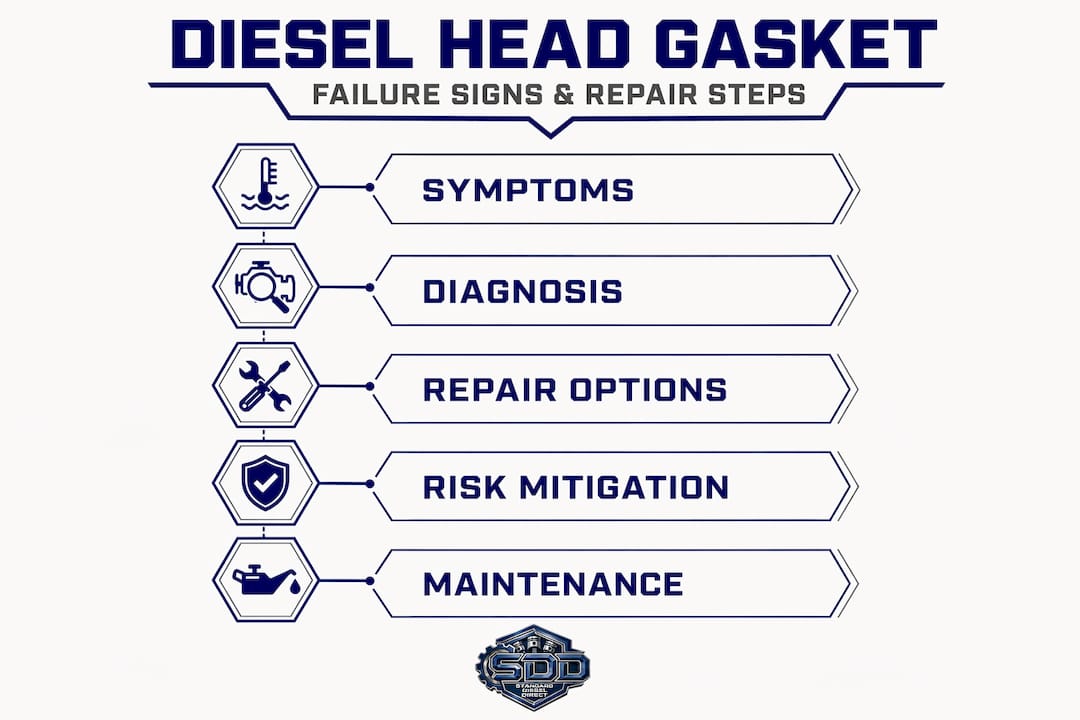
The indicators of a failed diesel head gasket include white or sweet-smelling exhaust smoke, milky or foamy oil on the dipstick or filler cap, persistent coolant loss with no visible external leak, chronic overheating, and a drop in compression. These signs of head gasket failure often appear in combination, and the more of them present at once, the more urgent the situation.
| Symptom | What it suggests |
|---|---|
| White/sweet exhaust smoke | Coolant entering the combustion chamber |
| Milky oil or foamy dipstick | Coolant mixing with engine oil |
| Coolant loss, no external leak | Combustion gases displacing coolant internally |
| Persistent overheating | Combustion gas blocking coolant circulation |
| Compression loss on one or more cylinders | Combustion seal breach between adjacent cylinders |
Not every symptom points exclusively to the head gasket. White smoke can come from a failed EGR cooler. Milky oil can indicate a cracked oil cooler. Overheating alone has a dozen possible causes. That overlap is why further testing is always necessary before tearing into the engine.
Before calling a tow truck, do a quick visual check:
-
Check coolant level in the reservoir and radiator (cold engine only).
-
Pull the dipstick and look for a milky, frothy appearance.
-
Observe exhaust color at startup and under load.
-
Watch the temperature gauge during a short idle.
-
Look for coolant puddles under the truck and around hoses.
If coolant is low but oil looks clean and exhaust is normal, you may be able to drive carefully to a shop. If oil is milky or exhaust is white and persistent, do not drive the truck.
Why diesel head gaskets fail
Heat is the leading cause. Running a diesel hotter than its design temperature causes the cylinder head and block to expand beyond their tolerances, compromising the gasket’s clamping seal. The most common root causes of diesel head gasket failure are:
-
Overheating/thermal distortion: Coolant system failures, a stuck thermostat, or a clogged radiator can push temperatures past safe limits quickly.
-
High combustion pressures from tuning or boost: Aggressive power tunes raise peak cylinder pressure above what the stock gasket was designed to handle, leading to head lift and seal failure.
-
Warped or damaged head/block surfaces: Even minor surface imperfections allow combustion gases to find a path past the gasket under pressure.
-
Loss of clamping force from stretched bolts: Torque-to-yield head bolts stretch during initial installation and must never be reused. Reinstalling them reduces clamping force and is a frequent contributor to repeat failures.
-
Corrosion and age: Coolant that has not been serviced on schedule becomes acidic and attacks gasket materials and sealing surfaces over time.
-
Poor installation: Incorrect torque sequence, wrong surface finish, or failing to use an angle gauge during final torque allows gasket creep and uneven clamping.
When engines are tuned for significantly more power, cylinder head lift becomes a real risk. At high boost levels, combustion pressure can physically separate the head from the block momentarily, breaking the gasket seal. The fix is stronger clamping through head studs and a performance MLS gasket rated for the application.
Pro Tip: Surface preparation is not optional. Any scratch, warp, or incorrect microfinish on the deck surface will cause a new gasket to fail, often faster than the original. Always have the head and block measured for flatness by a machine shop before reassembly.
How technicians confirm a head-gasket failure
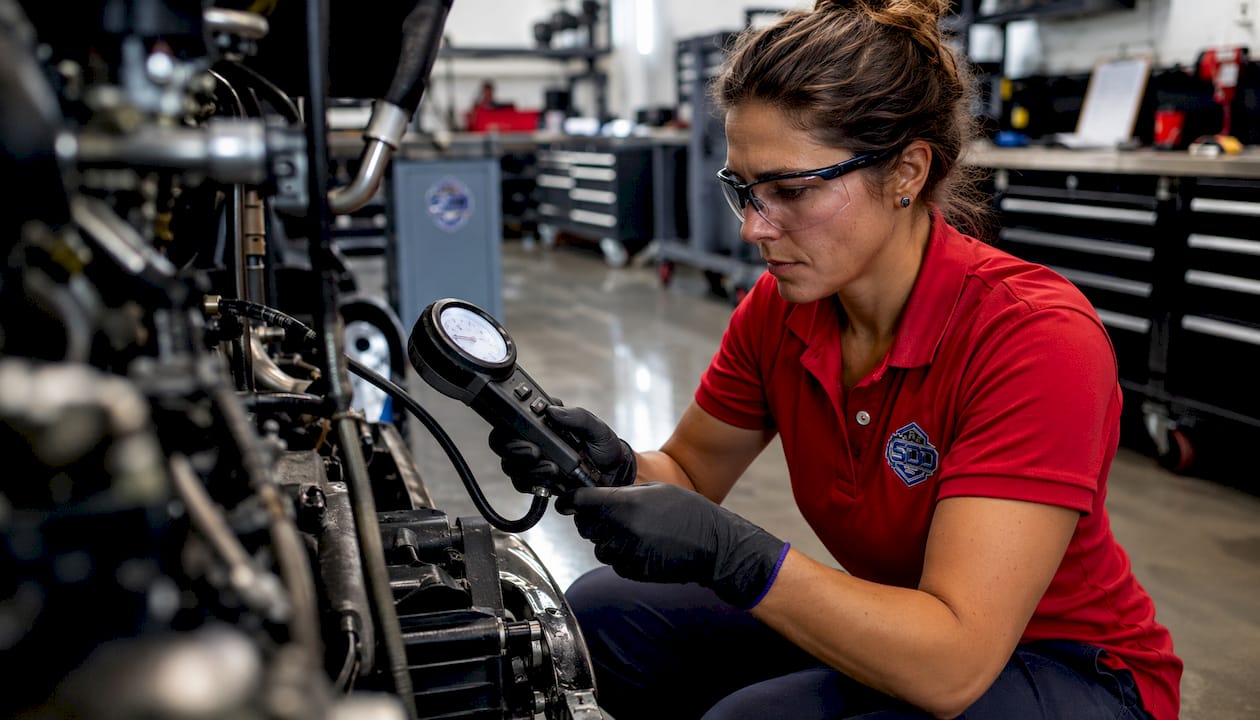
A proper diagnostic sequence saves you from unnecessary teardown costs. Start simple and escalate only when needed.
-
Visual inspection: Check oil and coolant appearance, look for external leaks, observe exhaust color.
-
Cooling-system pressure test: Pressurize the cooling system and watch for pressure drop; a drop with no visible external leak points to an internal breach.
-
Chemical block test: A combustion gas detector fluid (such as a block test kit using blue indicator fluid) changes color in the presence of exhaust gases in the coolant. This is a fast, non-invasive confirmation of a combustion-to-coolant leak.
-
Compression test: Measures cylinder pressure; low readings on adjacent cylinders suggest a gasket breach between them.
-
Leak-down test: Pressurizes each cylinder and measures how fast it loses pressure; identifies whether the leak path goes to the coolant, adjacent cylinder, or crankcase.
-
Oil and coolant cross-contamination inspection: Milky oil or a sweet smell in the coolant confirms fluid mixing.
| Test | What it detects | Positive result means |
|---|---|---|
| Cooling-system pressure test | Internal or external coolant leak | Pressure drops with no visible leak |
| Chemical block test | Combustion gases in coolant | Indicator fluid changes color |
| Compression test | Cylinder seal integrity | Low or uneven readings across cylinders |
| Leak-down test | Location of compression leak | Bubbles in coolant, hiss in crankcase |
Before confirming a head gasket diagnosis, rule out EGR cooler and oil cooler failures first. Both can produce nearly identical symptoms and are far cheaper to replace. A proper diagnostic sequence using the chemical block test and cooling-system pressure test will confirm combustion gas in the coolant without requiring engine disassembly.
Most of these tests are shop-level procedures. A compression test is within reach for an experienced DIYer with the right adapter set. The chemical block test is straightforward and inexpensive. Leak-down testing requires a dedicated tester and some mechanical confidence. When in doubt, have a diesel-experienced shop run the full sequence.
What happens if you keep driving with a bad head gasket
The risk is not linear. A minor external coolant seep may allow a careful, short drive to a shop. Anything beyond that is a gamble with the entire engine.
Driving with a confirmed head gasket failure risks warped cylinder heads from sustained overheating, damaged cylinder liners from coolant in the combustion chamber, bearing damage from oil diluted with coolant, and, in severe cases, hydrolock or engine seizure. These outcomes turn a $1,500–$3,000 head gasket repair into a $6,000+ engine rebuild or replacement.
Stop driving immediately if you observe:
-
White smoke that persists beyond the first minute of warm-up
-
Rapid coolant loss (reservoir dropping within minutes of running)
-
Milky or foamy oil on the dipstick
-
Temperature gauge climbing into the red
A slow coolant loss with clean oil and normal exhaust color is a borderline case. Top off the coolant, monitor the temperature gauge closely, and get to a shop the same day. Do not push it.
Repair choices and what they typically cost
A diesel head gasket replacement is not a simple swap. The repair almost always involves additional machine work and fastener replacement.
Typical repair steps:
-
Remove the cylinder head and inspect for cracks.
-
Measure head and block deck surfaces for flatness and microfinish.
-
Resurface or replace the head if it is warped or below spec.
-
Replace the head gasket with an OEM or performance MLS unit.
-
Replace all head bolts or upgrade to head studs (never reuse torque-to-yield bolts).
-
Reassemble with the correct torque sequence and angle, then pressure-test.
| Repair scope | Typical U.S. cost range | Estimated shop time |
|---|---|---|
| Gasket replacement, minimal machine work | $1,500–$3,000 | 10–15 hours |
| Gasket + head resurfacing | $1,500–$3,000 | 10–15 hours |
| Full head service (new head, studs, coolant flush) | $3,000 | 10–15 hours |
| Engine rebuild or replacement | $6,000+ | Varies |
If the engine has high mileage, known internal damage, or multiple failed components, a rebuild or replacement may be more cost-effective than a head-only repair. For modified engines, this is also the right moment to upgrade to performance MLS gaskets and ARP or equivalent head studs rather than reinstalling OEM hardware.
How to lower the risk of head-gasket failure
Prevention comes down to two things: keeping the cooling system healthy and not asking more from the gasket than it was designed to give.
Maintenance checklist:
-
Flush and replace coolant on the manufacturer’s schedule; degraded coolant becomes acidic and attacks sealing surfaces.
-
Inspect the thermostat and radiator cap annually; a stuck thermostat is one of the fastest paths to overheating.
-
Check coolant level and condition monthly on high-mileage or modified trucks.
-
Pull the dipstick regularly and look for any milky discoloration.
-
Inspect for external leaks at the head gasket seam during oil changes.
For trucks running power upgrades, the stock gasket and head bolts are often the weakest link. A diesel performance upgrade that raises cylinder pressure without addressing clamping hardware is a setup for failure. Upgrade to a performance MLS gasket and high-strength head studs before pushing power beyond the stock tune. An intercooler upgrade also reduces charge air temperatures, which lowers combustion heat load on the gasket.
Modified engines should have the head surface inspected by a machine shop every 50,000–75,000 miles or any time the engine is apart for other work.
Pro Tip: If you are running a performance tune, have a machine shop check head and block flatness before the gasket shows symptoms. Catching a warped deck early costs a few hundred dollars. Catching it after a failure costs several thousand.
Expert installation guidance and questions to ask your mechanic
Installation quality determines whether a new gasket lasts 200,000 miles or fails in 10,000. The gasket itself is only part of the equation.
Installation best practices:
-
Confirm deck flatness is within OEM spec (typically within 0.002–0.004 inches across the surface).
-
Achieve the correct microfinish for the gasket type; MLS gaskets require 30–60 RA, while composite gaskets tolerate rougher surfaces.
-
Always replace torque-to-yield head bolts; stretched bolts cannot maintain the required clamping load.
-
Use head studs instead of bolts on modified or high-boost engines for more consistent and higher clamping force.
-
Follow the manufacturer’s torque sequence exactly, including any angle-torque steps; skipping the angle stage is a leading cause of uneven clamping and early failure.
-
Apply thread lubricant or sealant only where specified; dry threads change the torque-to-clamp relationship.
Questions to ask your mechanic before authorizing the repair:
-
Did you measure head and block flatness, and what were the readings?
-
What surface finish did you achieve, and is it within spec for the gasket type?
-
Are you replacing the head bolts, or upgrading to studs?
-
Can you show me the torque records or photos of the head surface?
-
Is the head being pressure-tested for cracks before reassembly?
A shop that cannot answer these questions clearly is a shop that may be cutting corners on the work that determines whether the repair holds.
Key Takeaways
A diesel head gasket seals combustion pressure and separates oil and coolant; when it fails, white smoke, milky oil, or persistent coolant loss are the red-flag symptoms that require immediate diagnosis and, in most cases, a tow rather than a drive to the shop.
| Point | Details |
|---|---|
| Stop driving on these symptoms | White smoke, milky oil, or rapid coolant loss mean tow the truck — do not drive it. |
| Test before you tear down | Run a chemical block test and cooling-system pressure test to confirm the failure and rule out EGR or oil cooler issues first. |
| Diesel pressures are extreme | Stock light-truck diesels run 1,800–2,200 psi; modified engines need performance MLS gaskets and head studs to match. |
| Installation precision prevents repeat failures | Surface flatness and a 30–60 RA microfinish are required for MLS gaskets; always replace torque-to-yield bolts. |
| Standard Diesel Direct for performance upgrades | For modified diesel trucks, Standard Diesel Direct carries performance parts to support higher-output builds safely. |
Standard Diesel Direct Has the Parts Your Build Needs
When a head gasket job reveals that your diesel is ready for more than a stock rebuild, the supporting fuel and cooling systems need to keep pace with the added cylinder pressure. Standard Diesel Direct specializes in high-performance aftermarket parts for light-duty diesel trucks, including fuel systems engineered for builds running well beyond stock power levels.

Owners running modified Cummins, Duramax, or Powerstroke engines can browse purpose-matched fuel systems, from the Titanium Signature Series for 1998–2004 Cummins to options for later-model platforms, all backed by technical guidance that matches the depth of the repair work you just did. If you are rebuilding with upgraded hardware, do not leave the fuel system as the weak link. Visit Standard Diesel Direct to find the right fit for your truck and power level.
Recommended
-
Diesel Lift Pump Performance, Failure, Benefits, Upgrades, and Buying Guide – Standard Diesel Direct
-
Diesel Intercooler Upgrade Guide for Truck Owners – Standard Diesel Direct
-
What Is a Diesel Throttle Body? Function and Facts – Standard Diesel Direct
-
Diesel Particulate Filter Explained for Truck Owners – Standard Diesel Direct